Almost every article about ABNs is written as a compliance question: here is the form, here is the tax office, go and be a good citizen. That framing is why so many freelancers put it off. The sharper reason to sort this out is commercial. If you invoice an Australian business and you do not quote an ABN, that business is required by law to withhold 47% of what it owes you and send it to the ATO — and if it fails to withhold, the penalty falls on the client, not on you. An ABN is not paperwork you do for the tax office. It is the thing that makes you payable.
This is general information about how the rules work, not tax advice about your situation. The thresholds below are quoted from the ATO and the dates they were last updated are on each page. If your circumstances are unusual, or the amounts are large, talk to a registered tax agent before you act.
What an ABN actually is, and what it is not
An Australian business number is an identifier you quote when you deal with other businesses. It is issued by the Australian Business Register, and it is free. As business.gov.au puts it, “It’s free to register for an ABN through the Australian Government’s Australian Business Register (ABR)”. Anyone charging you for the application is charging you for typing.
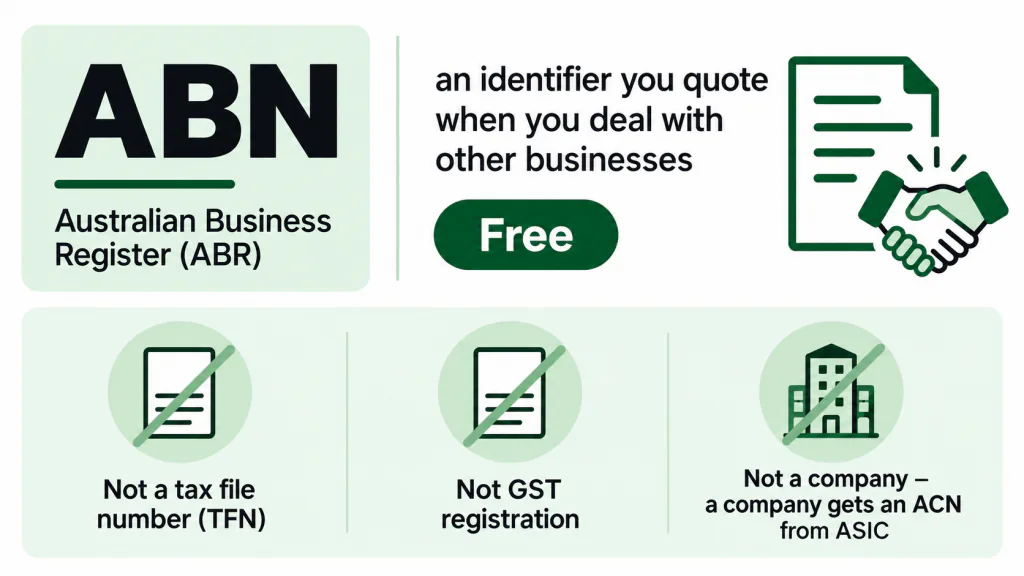
Three things get confused constantly, and untangling them saves a lot of wasted worry:
- An ABN is not a tax file number. business.gov.au states plainly that an ABN “doesn’t replace your tax file number”. As a sole trader you still lodge one income tax return under your own TFN, with a business schedule in it.
- An ABN does not mean you charge GST. These are two separate registrations. Having an ABN says nothing about whether GST applies to your invoices. That is decided by a turnover threshold, covered further down.
- An ABN is not a company, and it does not limit your liability. A company is registered with ASIC and gets an Australian company number instead — ASIC notes that when you register a company, the ACN it issues can even serve as the company’s name. If you are a sole trader with an ABN, you and the business are the same legal person. Getting an ABN changes nothing about who is liable if something goes wrong.
If you are still working out which of these you are, the comparison in sole trader, freelancer or contractor covers the structure question separately.
The 47% rule: why your client cares more than you do
This is the part worth understanding properly, because it explains why a client’s finance team will stall your first invoice.
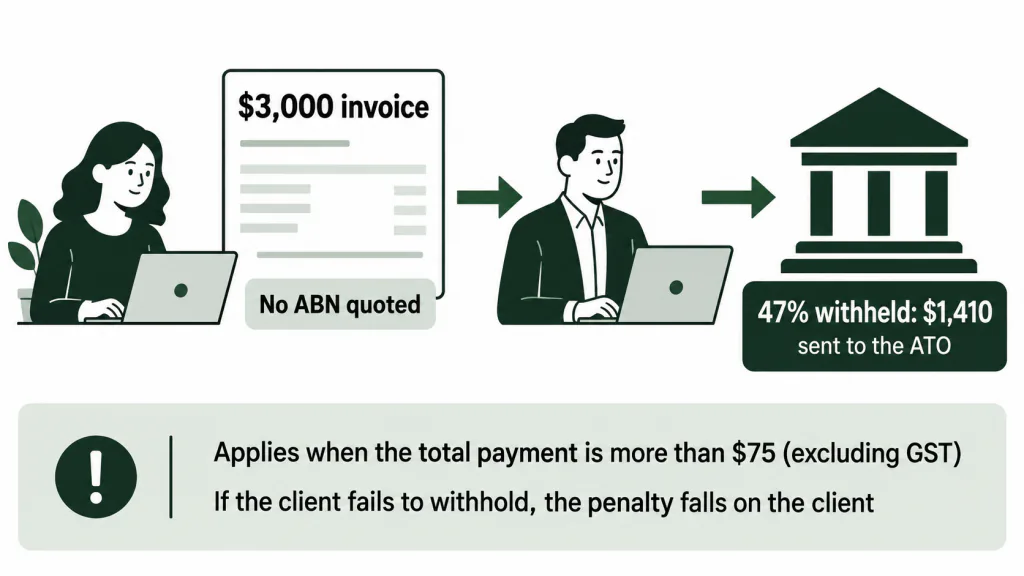
Under the no-ABN withholding rules, the ATO’s own guidance for payers says: “Payers must withhold 47% (from 1 July 2017) from the total payment for a supply” unless the supplier’s ABN is quoted on an invoice or another document relating to the supply, or an exception applies. The threshold is low: withholding kicks in when “the total payment for goods and services is more than $75 (excluding GST)”.
Then the sting, which is aimed squarely at your client: “Payers may be subject to penalties if they do not withhold an amount when required. The penalty will be equal to the amount that should have been withheld. It is an offence not to withhold.” The ATO also tells payers they must not simply pay in full on a promise that an ABN is coming later.
Read that from the client’s side. A procurement officer who pays your $3,000 invoice without an ABN on it is personally creating a $1,410 exposure for their employer, plus an offence. This is why “we can’t set you up as a supplier yet” is not obstruction and not a negotiation. There is nothing they can do for you.
Two practical consequences:
- Put the ABN on the quote, not just the invoice. The ATO accepts an ABN quoted on quotes, order forms, contracts, letterheads, emails and web pages — not only invoices. Getting it onto the document the client files at the start removes the question before it is asked. Writing the quote is the right moment.
- If you have applied but not received it, say so and agree to hold the invoice. The ATO explicitly allows a payer to delay payment until the ABN is quoted, and describes it as a matter for you and the client to work out. What you cannot do is ask them to pay now and take your word for it.
Am I actually in business, or is this a hobby?
You are only entitled to an ABN if you are carrying on or starting an enterprise. Plenty of people doing occasional paid work genuinely are not, and the honest answer for them is not to register.
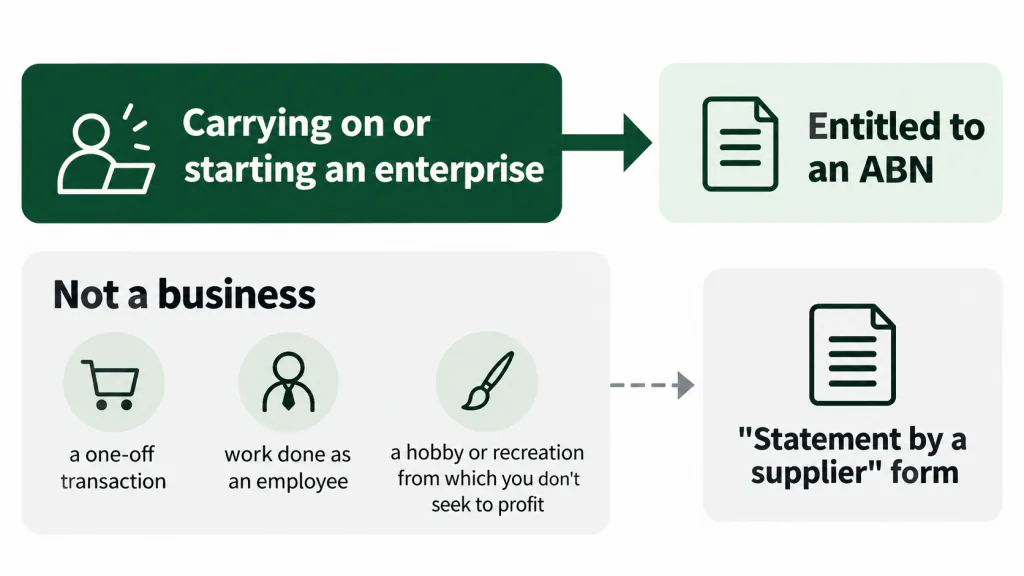
The ATO’s test is in Are you in business?, and it is more useful than it looks. It starts from a definition — “Generally, a business involves a set of continuous and repeated activities you do for the purpose of making a profit” — and then gives a set of questions where “the more of the following questions you answer yes to, the more likely it is your activities are a business”:
- Do you intend to be in business?
- Do you intend to and have a prospect of making a profit?
- Is the size or scale of your activity enough to make a profit?
- Are the activities repeated and continuous?
- Are your activities planned, organised and carried out in a business-like manner — separate bank account, records kept, advertising to the public rather than to friends, a business name?
The ATO also lists what is not a business: a one-off transaction that is not the first step in a business and is not intended to be repeated, work done as an employee, and “a hobby or recreation from which you don’t seek to profit”. Note the direction of travel in their own examples — someone who starts posting videos for fun and then sets a production schedule, buys equipment and joins a monetisation programme has moved across the line. The ATO says that if your activity changes in a major way, you must reassess.
The form nobody tells you about
If you are not carrying on an enterprise, you are not stuck choosing between registering for something you are not entitled to and losing 47% of a one-off payment. There is a Statement by a supplier form, and an individual can use it where the supply was made as a private recreational pursuit or hobby, or was wholly private or domestic in nature, or where the payment does not exceed $75 excluding GST, or where the individual is under 18 and paid no more than $350 a week. The ATO gives the example of a hobby artist winning a $100 prize in a shopping centre art show.
The limit is equally clear: “If the supplier is operating a business or is entitled to register for an ABN, they cannot use the Statement by a supplier form.” It is an exit for people genuinely outside business, not a way to avoid registering.
$75 and $75,000 are not the same number
These two figures cause more confusion than anything else in this area, and they are unrelated.
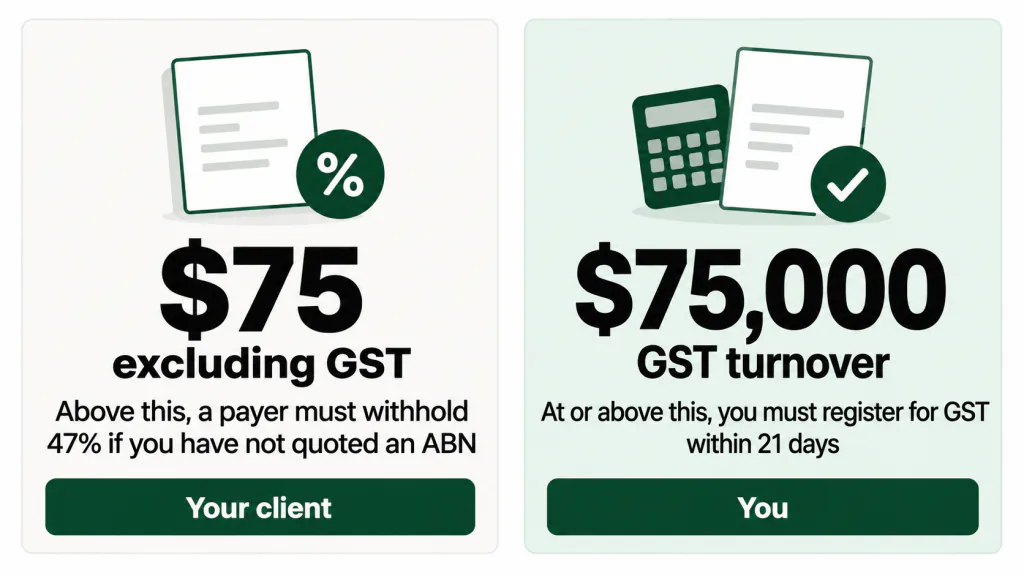
| Figure | What it governs | Who acts on it |
|---|---|---|
| $75 excluding GST | Above this, a payer must withhold 47% if you have not quoted an ABN | Your client |
| $75,000 GST turnover | At or above this, you must register for GST | You |
On the second one, the ATO’s registration guidance says you must register when your enterprise “has a GST turnover (gross income from all businesses minus GST) of $75,000 or more”, or when you start a business and expect to reach that in the first year. Turnover means total business income, not profit. Once you are required to register, “you need to do so within 21 days”, and the ATO’s advice if you are under the threshold is to check every month.
Two details that catch people out. You need an ABN before you can register for GST — the ATO states that directly. And there are activities where GST registration is required regardless of turnover, including taxi and ride-sourcing work and claiming fuel tax credits. If you are near the line, check your turnover every month, as the ATO advises, rather than once a year at tax time. Overseas clients count towards that turnover even though their invoices carry no GST, which is covered in when freelancers in Australia have to register for GST.
Getting one, and keeping it
Apply through the Australian Business Register, which you can reach from the government’s ABN registration page. business.gov.au says to have three things ready before you start: your business structure, proof of identity, and details of your business activities and associates. If you give all the information needed, you get a result as soon as you finish the online application — an ABN, a refusal number, or a reference number if it needs a look. Where it goes to review, business.gov.au notes that “Reviews can take 20 business days and the ATO may contact you for more information”.
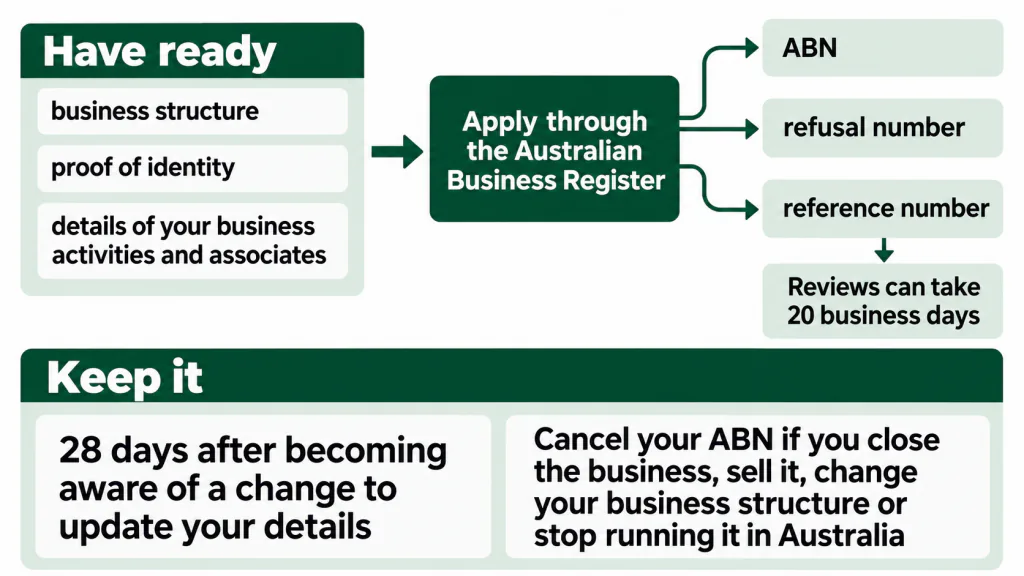
That last line is the one to act on. If a client has told you they need an ABN before they can raise a purchase order, do not assume tomorrow. Apply before you need it.
An ABN is also something you maintain, not something you get once and forget. business.gov.au says you have 28 days after becoming aware of a change to update your details, and that you need to cancel your ABN if you close the business, sell it, change your business structure or stop running it in Australia. Moving from sole trader to a company is a structure change, so it means a new ABN, not an edit to the old one.
Where the ABN has to appear once you have it
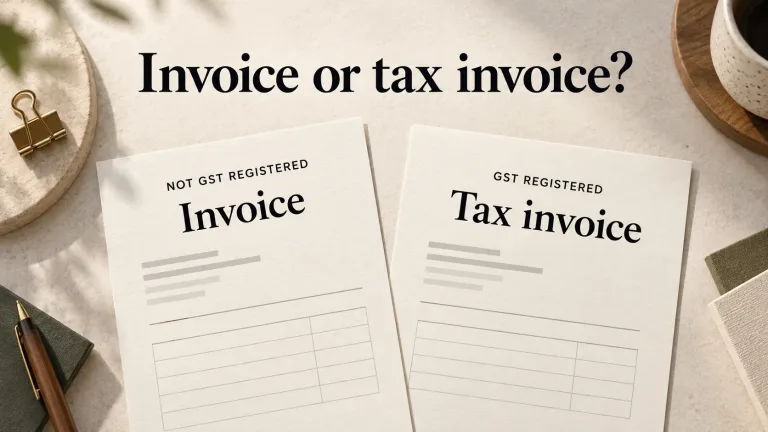
Your ABN belongs on anything the client might file against the payment. If you are registered for GST and issuing tax invoices, it is not optional: the ATO’s tax invoice requirements list the “Seller’s Australian business number (ABN)” among the seven details a tax invoice for a sale under $1,000 must contain, and a tax invoice must be provided within 28 days of a customer asking, unless the sale is $82.50 including GST or less. Above $1,000 the list grows, and the tax invoice must also show the buyer’s identity or ABN. A template that meets both sets of rules, and the fields your client’s accounts payable team looks for, is in what to put on a freelance invoice in Australia.
If you are not registered for GST, you are issuing an invoice rather than a tax invoice, and you should not be charging GST on it. Putting your ABN on it anyway is still the right move, because that is the document that stops the withholding.
What to do this week
- Work out whether you are carrying on an enterprise, using the ATO’s questions above. If the answer is no, note that the Statement by a supplier form exists and move on.
- If the answer is yes, apply through the ABR today rather than the week a client asks. It is free, and the review path takes up to 20 business days.
- Add the ABN to your quote template, your invoice template, your email signature and your site. The point is to have quoted it before anyone in accounts payable has to ask.
- Write your current rolling turnover down somewhere you will see it monthly. The ATO’s registration page warns that if you register late you “may have to pay GST on sales made since the date you were required to register”, even where you never included GST in the price, and “may also have to pay penalties and interest”.
- Keep the ABN off the list of things you rely on memory for. Renewals, turnover checks and invoice follow-ups are all date-driven, which is what chasing late payments depends on too.
The whole thing takes an afternoon once and then sits in the background. The reason to do it now rather than when a client raises it is that the alternative is explaining to someone in accounts payable why they should break a rule that penalises them, which is not a conversation you can win.