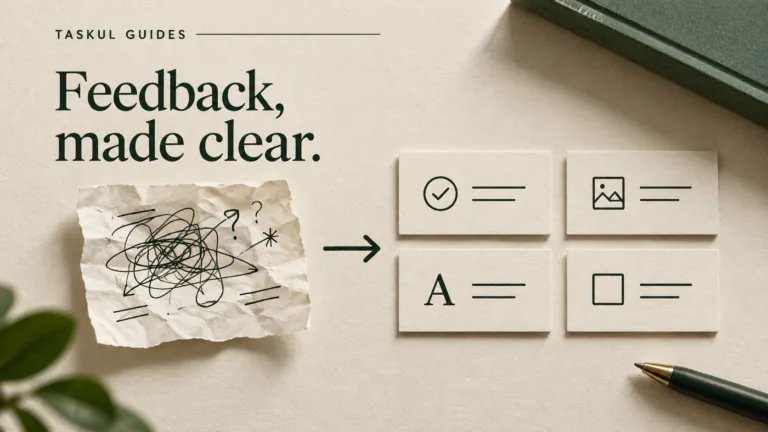

If you are trying to manage multiple clients as a freelancer and the week keeps getting decided by whoever messaged you last, the problem is almost never time management. It is that your commitments live inside five separate conversations instead of one list. Fix that and the rest of it — quoting, deadlines, chasing invoices — stops being a memory exercise.
This guide is written for people running client work on their own in Australia. Around 1.1 million people here worked as independent contractors in August 2025, about 7.6% of everyone employed, according to the Australian Bureau of Statistics in its Characteristics of Employment release. Most of them are doing the delivery, the sales, the quoting and the chasing from the same desk on the same day.
Why does managing multiple clients fall apart?
It falls apart because you do not have a list. You have inboxes. A change request arrives in an email thread, a second one comes through Slack, a third gets mentioned on a call, and a fourth turns up as a voice message while you are driving. Each of those is a promise you have now made. None of them are written down anywhere you will look on Monday morning.
So the week gets ordered by recency and volume. The client who messages the most gets the most work, and the client who is polite and quiet gets pushed until they stop being either. You are not disorganised. You are running an operating system where the queue is owned by other people.
The three things that actually go wrong
- Invisible commitments. Anything agreed in a conversation and not written into a task does not exist. It will still be expected.
- Re-deciding. Every switch between clients costs you the time it takes to rebuild the context: what stage is this at, what did I promise, what am I waiting on. Doing that eight times a day is the real cost, not the work itself.
- Unquoted work. Work that never made it into a quote does not appear in your schedule and does not appear on an invoice. You do it anyway, and it is the part of the month you were never paid for.
Step 1: Keep one list of commitments, not one per client
The single highest-value change is to separate where a request arrived from where it lives. Email, Slack and phone calls are delivery channels. They are not storage. Every time something is agreed, it goes into one list that covers every client, with a due date and the client’s name attached.
This sounds obvious and almost nobody does it, because the moment the message arrives you are already in that client’s context and it feels handled. It is not handled. It is read.
Two rules make this stick:
- Nothing is agreed until it exists as a task with a date. If you say yes in a call, you write it down before the next call.
- One list, sorted by date, across all clients. Not a board per client that you have to visit to remember.
Getting a brief into that list is the slowest part, which is why we built TASKUL to take the email itself: you paste what the client sent, and it comes back as a project with the tasks and a draft quote. The method matters more than the tool, but the method dies if entry takes ten minutes each time.
Step 2: Decide what you owe this week before anybody asks
On Monday, before opening any client channel, answer three questions in writing:
- What is due this week, across every client?
- What is blocked, and who is blocking it?
- What did I promise that has no date on it yet?
The third question is the one that saves you. Undated promises are where the “I thought you were doing that” conversation comes from. Give each one a date, even a rough one, and tell the client the date. You have now converted an open-ended obligation into something with an end.
Doing this before you open Slack matters because once you are in the channel you are answering, not deciding.
If you would rather see this worked through one week than described in steps, how to prioritise multiple client projects follows three live jobs from a Monday plan to a problem on Thursday, and shows the arithmetic behind each decision.
Step 3: Make what you are waiting on visible
Half of a freelancer’s stalled work is not stalled on you. It is waiting on copy, logins, a decision, an approval, or a signature. If that is not tracked, two bad things happen: you carry the anxiety for work you cannot progress, and the client genuinely does not know you are blocked.
Keep a “waiting on” state and a date you asked. When it ages past a week, send a single line: “Still need the logo files to finish the header — can you send them today or should I move the deadline?” That sentence does two jobs. It asks, and it puts the consequence in front of them without any conflict in it.
Why does this matter more in Australia?
Because the rest of the chain is slower than you think. The Payment Times Reporting Regulator, which publishes what large Australian businesses actually do, reported in its July 2025 update that 74.7% of reporting entities had standard payment terms of 20 days or less, and 90.2% of payments were made within 30 days. That is the good end of the market — big businesses that are legally required to report. Everyone else is unmeasured. If your delivery slips two weeks because you were waiting on assets, the money slips with it.
Step 4: Quote the work before you start it
Quoting is not admin you do to get paid. It is the step that decides what goes in your week. A quote with a written scope is the only thing that lets you say “that is a new item” without it becoming an argument.
If you are unsure how much detail to put in, the short version is: list what is included, list what is not, and state what a change costs. We go through the whole document, including how to handle GST on a quote, in how to write a quote for freelance work in Australia, and the scope side specifically in how to stop scope creep before it starts.
One Australian detail worth knowing before you send anything: if you do not quote an ABN on the invoice, the client generally has to withhold tax at the top rate from the payment where the total is more than $75 excluding GST, and pay it to the ATO instead of to you. That is the rule on the ATO’s page for withholding if an ABN is not provided. It is not a penalty aimed at you, it is the default, and it is the fastest way to turn a good month into a cash flow problem.
Step 5: Chase money on a schedule, not on a feeling
Most freelancers chase late invoices when they notice, which means when they need the money or when they are annoyed. Both are bad timing, and both make the message harder to write.
Put the follow-up in the same list as the work: a task on the due date, one a week later, one at two weeks. Then the message is routine rather than confrontational, and you never have the conversation where you realise something is 70 days old. The full sequence, including where it goes when a client simply will not pay, is in how to chase late payments as a freelancer in Australia.
How many clients can one freelancer handle?
There is no universal number, and anyone who gives you one is selling something. The useful question is not how many clients, it is how many active decisions you are holding. A retainer client who sends one clear brief a month costs you almost nothing. A client in the middle of a launch who changes direction twice a week can cost more than three others combined.
Count active projects, not logos. When you are deciding whether to take the next one, work out what you already owe in that period first — we go through how to do that in working out whether you can take on another client this month.
The same five habits can also be run as a set of checks at the four moments a job usually slips. The freelance project checklist sets those out, from the brief through to the invoice follow-up.
What should this actually look like day to day?
A workable setup for one person with several clients has five parts, and only five:
- One list of every commitment, with dates and client names.
- A weekly review that happens before you open any client channel.
- A quote for every piece of work, with scope written down.
- A “waiting on” state so blocked work is visible instead of anxious.
- Scheduled follow-ups for invoices, set when you send them.
You can run all of that in a notebook. Most people do not, because the entry cost kills it by week three. Whatever you use, the test is simple: on Monday morning, can you see everything you owe this week without opening a single client’s inbox? If the answer is no, that is the thing to fix first.
The entry cost is also the part worth automating, and it is the only part of your admin where that works well — which tasks are actually worth handing over is in AI for freelance admin: what actually saves time on client work.
Frequently asked questions
Should I use a separate project board for each client?
Only for the detail. You still need one combined view sorted by date, because your week is shared across clients even though your boards are not. A board per client tells you the state of that client. It never tells you what Thursday looks like.
How do I stop a client from expecting instant replies?
Tell them your response window once, in writing, at the start: “I check messages twice a day and reply the same day.” Almost nobody objects, because the complaint is never about speed, it is about not knowing. What breaks trust is replying in four minutes on Tuesday and going silent on Wednesday.
What do I do when two clients need the same day?
Tell the one you can move first, before the day arrives, and offer a specific new date. A deadline moved five days out with notice is a scheduling detail. The same deadline missed on the day is a broken promise, and those are what lose clients.
Do I need an ABN to freelance in Australia?
You do not legally need one to do work, but without an ABN on the invoice a business paying you more than $75 excluding GST generally has to withhold tax at the top rate and send it to the ATO, under the rule on withholding if an ABN is not provided. You also need an ABN before you can register for GST. In practice most Australian clients will ask for one before they raise a purchase order. What the ABN does and does not change is covered in freelancer, sole trader or contractor.
When do I have to register for GST?
Once your GST turnover reaches $75,000 a year, or you expect it to. The ATO requires you to register within 21 days of hitting that threshold, and GST is 10%. The current rules are on the ATO’s registering for GST page. It changes how you quote, so read it before your next proposal rather than after.