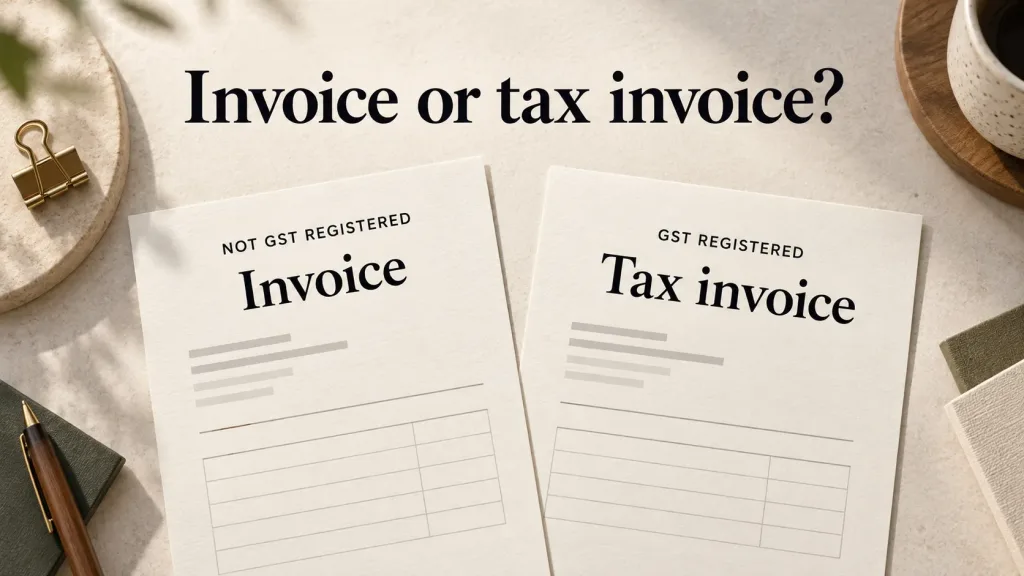
Search for a freelance invoice template and you will be handed a hundred of them, most written for the United States, and a good number labelled “Tax Invoice” at the top. If you are not registered for GST, that heading is wrong on your document. An invoice and a tax invoice are two different things here, with different legal requirements, and knowing which one you are issuing decides what has to be on it.
This guide covers what the ATO requires, what it does not require but your client’s accounts payable system quietly does, and the two situations where the usual advice stops applying. It is general information rather than tax advice — the ATO pages linked below are the authority, and each one shows the date it was last updated.
Are you issuing an invoice or a tax invoice?
This is the first fork and everything else follows from it.
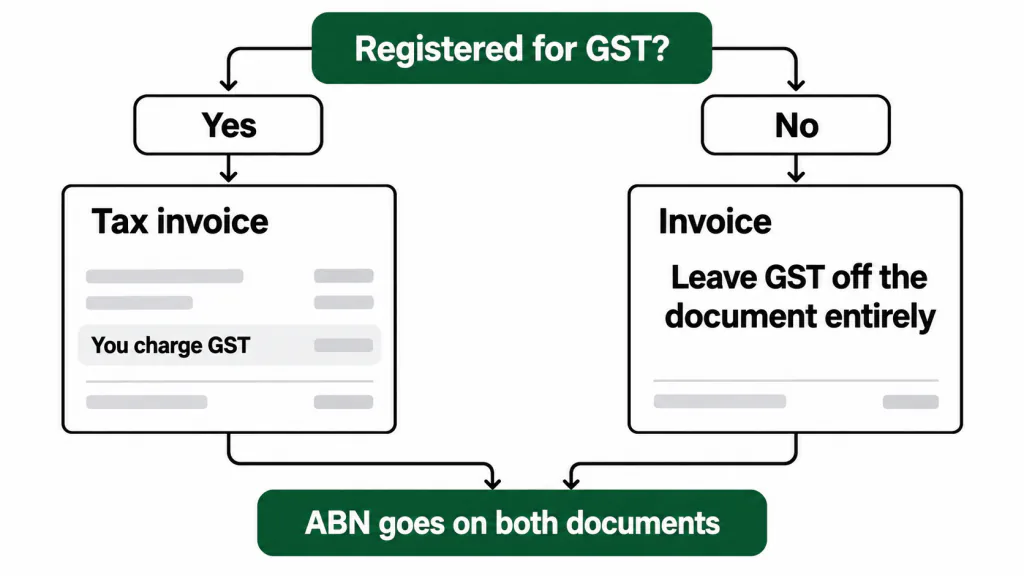
- Registered for GST? You charge GST, and the document you issue is a tax invoice. It has a specific list of required contents, set out below.
- Not registered for GST? You do not charge GST, and you issue a plain invoice. Do not label it a tax invoice, and do not put a GST line on it showing zero — just leave GST off the document entirely.
Whether you are registered comes down to turnover, not choice, once you pass the threshold. The ATO requires registration when your GST turnover reaches “$75,000 or more”, and you have 21 days from that point. Below it, registering is optional. The detail sits in GST for freelancers in Australia.
One thing goes on both documents regardless: your ABN. Without it, an Australian business paying you more than $75 excluding GST generally has to withhold tax from the payment, and the ATO’s statement for suppliers not quoting an ABN puts the rate at 47%. The ATO notes that a supplier “may quote their ABN on an invoice or other document relating to the supply”, and the invoice is the obvious place. That rule, and why the client cannot waive it, is in do I need an ABN to freelance in Australia.
The seven things a tax invoice must contain
For a taxable sale of less than $1,000, the ATO’s tax invoice requirements say the document must include enough information to clearly determine these seven details:
- That the document is intended to be a tax invoice
- The seller’s identity
- The seller’s Australian business number
- The date the invoice was issued
- A brief description of the items sold, including the quantity (if applicable) and the price
- The GST amount, if any, payable
- The extent to which each sale on the invoice is a taxable sale
Two of those are worth unpacking, because they are where freelance invoices go wrong.
The GST amount, and the shortcut most people miss
You can show GST as a separate line. But you do not have to. The ATO allows the amount to be shown “separately or, if the GST amount is exactly one-eleventh of the total price, as a statement which says ‘Total price includes GST'”. For a freelancer whose whole invoice is standard taxable services, that sentence is legitimately all you need, and it is cleaner than a tax column on a two-line invoice.
Where a fraction of a cent turns up, the ATO has rounding rules. With only one taxable sale on the invoice, round the GST to the nearest cent, rounding half a cent upwards. With more than one, there are two rules. Under the total invoice rule, you total the GST and round to the nearest cent; if every taxable sale on the invoice includes GST of exactly one eleventh of its price, you can instead add up the GST-exclusive values, calculate GST on that sum, and round. Under the taxable sale rule, you work out the GST for each sale, then add those amounts and round the total to the nearest cent. The ATO states that “You and your customers don’t need to use the same rounding rules.”
“The extent to which each sale is a taxable sale”
If every line on your invoice is taxable, “Total price includes GST” covers this. It matters when an invoice mixes taxable work with something that is GST-free or input-taxed. In that case the ATO requires the document to clearly show which items are taxable, each taxable sale, the amount of GST to be paid, and the total amount to be paid. Mixed invoices are where you should stop improvising and check, because the apportionment rules go beyond what a template can carry.
The $1,000 line, and the $82.50 line
Two dollar figures change your obligations, and neither is widely known.
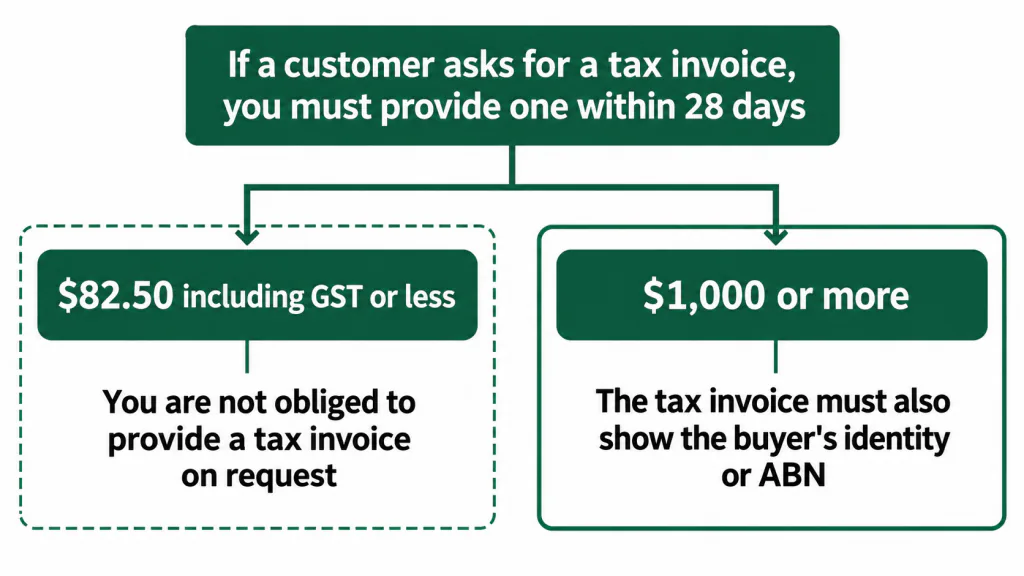
| Figure | What changes |
|---|---|
| $1,000 or more | The tax invoice must also show the buyer’s identity or ABN |
| $82.50 including GST or less | You are not obliged to provide a tax invoice on request |
On the first: the ATO states that “Tax invoices for sales of $1,000 or more also need to show the buyer’s identity or ABN”, and adds a useful piece of practical advice — if your invoice meets the requirements for sales of $1,000 or more, you can use that same format for smaller amounts. For a freelancer, that settles the design question. Build one template that includes the client’s legal entity name and ABN, and use it for everything. You will never have to think about the threshold again.
On the second: “If a customer asks for a tax invoice, you must provide one within 28 days, unless it is for a sale of $82.50 (including GST) or less.” Note the direction. The obligation is triggered by the customer asking, and 28 days is the outer limit, not a target.
Digital is fine. The ATO says a tax invoice “doesn’t need to be issued in paper form” and a PDF emailed to the client works, provided it contains everything required. Australia has also adopted the Peppol framework for eInvoicing, where invoices pass directly between the two parties’ software; larger clients and government buyers increasingly work this way, and the ATO accepts a compliant eInvoice as intended to be a tax invoice even without the words “Tax Invoice” on it.
When the client issues the invoice instead of you
Agencies, platforms and some large buyers sometimes tell you they will generate the invoice themselves. That is a recipient-created tax invoice, and it is a real mechanism rather than someone being difficult. The ATO permits an RCTI where both of you are registered for GST at the time it is issued, you have agreed in writing that they may issue it and you will not, the agreement is current, and the Commissioner has determined that this type of supply can be invoiced that way.
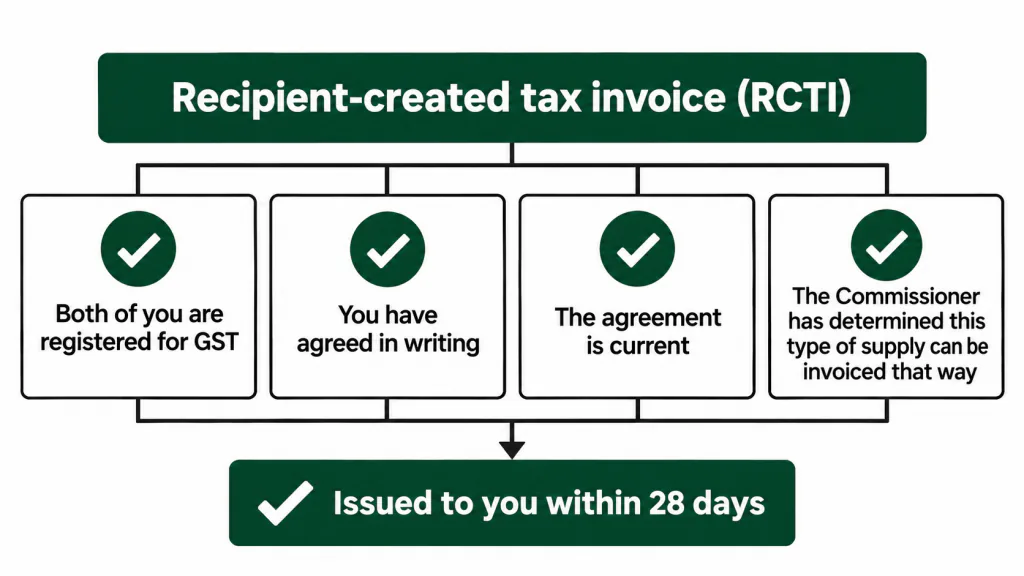
Three things to hold them to. The written agreement is not optional. The RCTI must show both ABNs, be identifiable as a recipient-created tax invoice rather than an ordinary one, and state that GST is payable by you if it is. And they must issue it to you within 28 days of the date of the sale or the date they determine its value. If a client wants to run RCTIs and there is no written agreement, ask for one before the first payment rather than after.
What the ATO does not require, but decides whether you get paid
An invoice can satisfy every legal requirement and still sit unpaid for two months. The reasons are almost never disputes about the work. They are that the document cannot travel through the client’s system. None of the following is a legal requirement, and each one is a reason an invoice stalls in accounts payable.
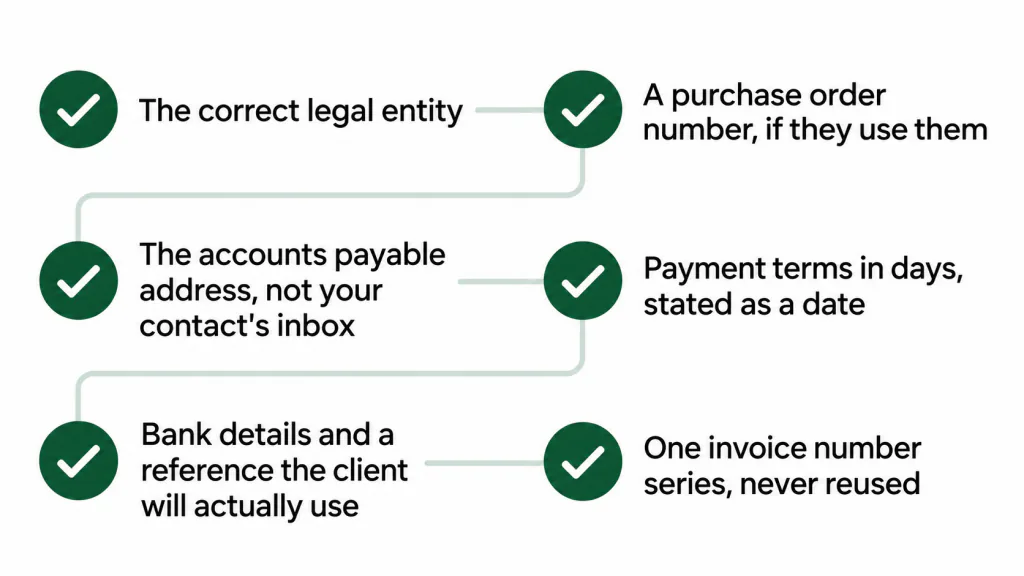
- The correct legal entity. Not the brand you see on their website — the entity that holds the budget. Getting this wrong means the invoice is rejected rather than queried, and often silently.
- A purchase order number, if they use them. In organisations that run POs, an invoice without one does not enter the queue at all. Ask at quote stage.
- The accounts payable address, not your contact’s inbox. Your contact approves; someone else pays. Sending only to the approver is the most common cause of an invoice that everyone agrees is fine and nobody has processed.
- Payment terms in days, stated as a date. “Payable within 14 days” plus the actual due date. Terms that first appear on the invoice are terms that get renegotiated on the invoice.
- Bank details and a reference the client will actually use. Your invoice number as the payment reference, so reconciliation is not guesswork on either side.
- One invoice number series, never reused. Sequential, no gaps you cannot explain.
Most of these are collected once, at the start of the relationship, not chased at billing time. That is what client onboarding is for, and it is the cheapest hour you will spend on a new client.
Record keeping, briefly
Keep a copy of every invoice you issue and every RCTI a client sends you. The ATO’s record-keeping rules say “You need to keep most records for 5 years”, with the period generally running from when the record was prepared or the transaction completed, whichever is later. Records must be in English or easily converted to it. Practically, this means your invoices need to be retrievable by client and by financial year without you rebuilding them from your email.
A working template
One document, used for every client, sized for the $1,000-and-above rules so the threshold never matters:
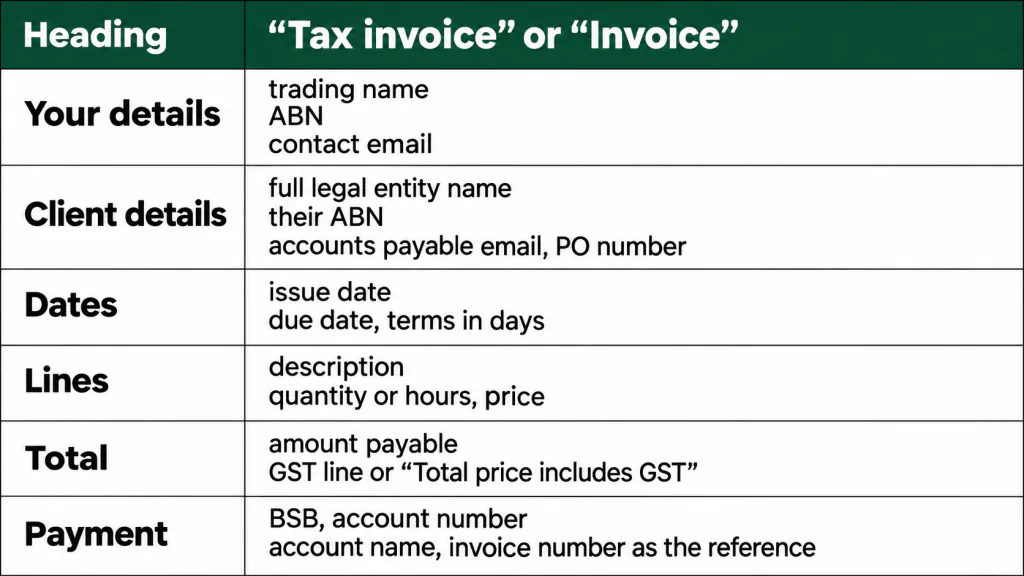
- Heading: “Tax invoice” if you are registered for GST. “Invoice” if you are not.
- Your details: trading name, your name if different, ABN, contact email.
- Client details: full legal entity name, their ABN, accounts payable email, PO number if they use one.
- Dates: issue date and due date, with the terms in days written next to them.
- Lines: a short description of what was delivered, the quantity or hours where relevant, and the price.
- Total: the amount payable, and either a GST line or “Total price includes GST” if you are registered and everything on the invoice is taxable.
- Payment: BSB, account number, account name, and the invoice number as the reference.
Set the follow-up date the day you send it rather than the day you notice it is late. What to do when the date passes — the reminder sequence, the letter of demand, and which tribunal or court handles small debts in your state — is covered in chasing late payments in Australia.