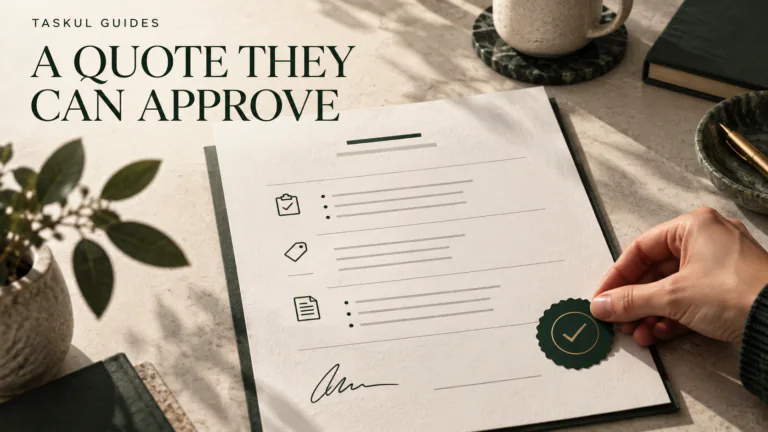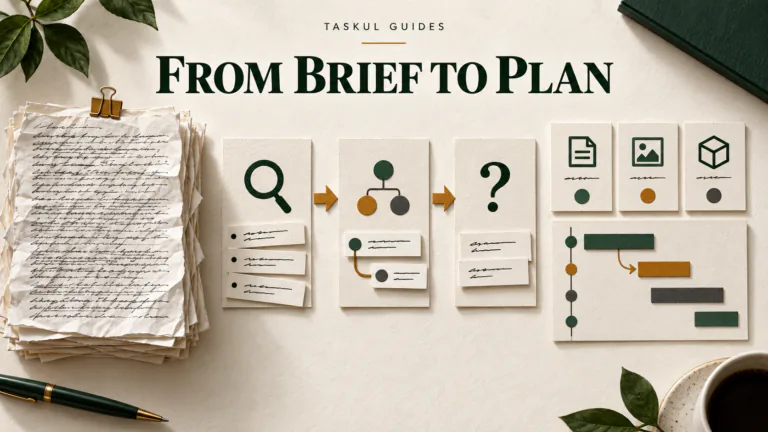
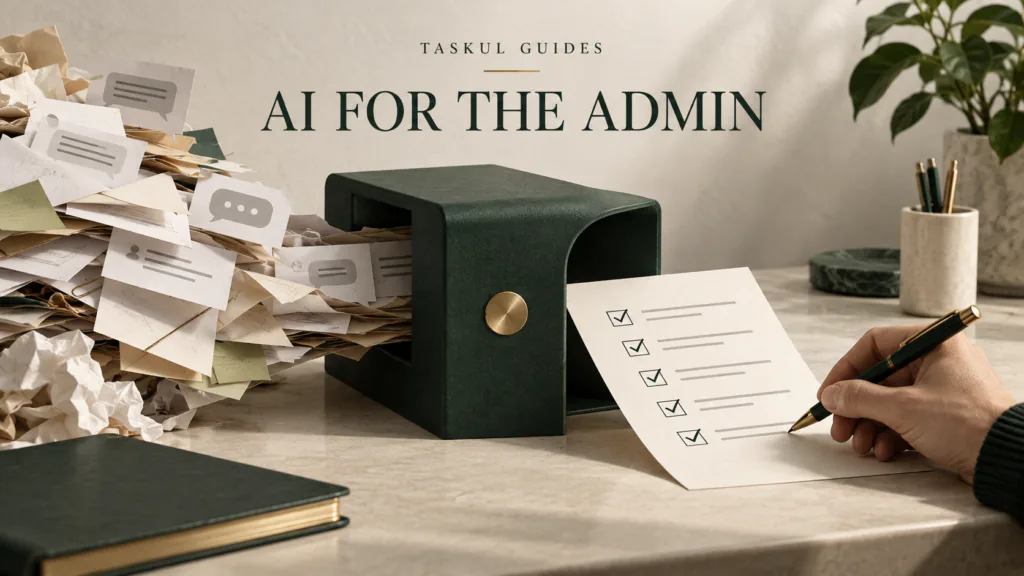
Almost every claim made about AI and freelance admin is either too excited or too dismissive. The useful version is narrower and more boring than both: AI is good at turning one form of text into another form of text, and a surprising amount of freelance admin is exactly that. A brief sitting in an email has to become a task list. A scope has to become a quote. Three weeks of messages have to become a status update a client can read in ten seconds.
What it is not good at is knowing anything about your business. It does not know what you charge, what you already committed to next Tuesday, or which of your clients needs a week of warning before a deadline moves. And on Australian tax and invoicing rules it will produce fluent, confident, out-of-date answers, which is the one place where a wrong answer costs you money.
Where does AI actually save a freelancer time?
Four things, and they have something in common: the input is already text you have, and a wrong output is obvious the moment you look at it.
1. Turning a brief into a structure
Client briefs arrive as prose. “We’re relaunching in November, the site needs to work on phones, and we want the blog to look less like a blog.” Somebody has to convert that into deliverables with dates, and that conversion is mechanical — it just takes forty minutes of the wrong kind of concentration.
This is the strongest use, because you are the one who checks the output, and you can see at a glance whether a line is missing. The method for doing it properly is in how to turn a client brief into a project plan, and the reason it matters is that everything downstream — your quote, your schedule, your scope boundary — is built on that structure.
2. Drafting the messages you send every week
The payment reminder, the status update, the “here’s what I need from you by Thursday” list. These are near-identical every time, they are emotionally annoying to write when the situation is annoying, and a neutral draft you then edit is faster than a blank page.
The gain is not the typing. It is that a drafted reminder goes out on the day it is due, while a reminder you have to compose from scratch waits until you are in the mood, which is usually a week later. The sequence that works is in how to chase late payments as a freelancer in Australia.
3. Compressing a long thread into what changed
A 40-message thread with a client contains perhaps six decisions. Pulling those six out is real work and nobody enjoys it. Getting a first-pass summary and then correcting it is genuinely faster, as long as you read the source rather than trusting the summary — a summary will quietly drop the one caveat that mattered.
4. First-pass extraction from documents
Pulling the entity name, ABN, contact and terms out of a client’s paperwork so you can set up the job. Useful, and you verify against the document. Never skip the verification: this is data that goes on invoices, and a wrong entity name is how an invoice sits unpaid for six weeks. What to collect is in client onboarding for freelancers.
Where it does not help, and where it hurts
- Deciding your price. A model has no idea what your business needs to bill or what your billable hours actually are. It will produce a plausible figure, and a plausible figure is worse than no figure, because it feels like an answer. Build the number from your own inputs instead — the method is in how much to charge as a freelancer in Australia.
- Anything that depends on your commitments. Whether you can take on a project in October is a question about your existing work, not a question about text. See working out whether you can take on another client this month.
- Client-facing work you have not read. Sending a draft you did not check is how a client receives their competitor’s name in their own case study.
- Judgement about a relationship. Whether to push back on a scope change or absorb it depends on things a model cannot see.
The Australian rule: never take a threshold from a chatbot
This is the single most important caution in the whole subject, and it is specific rather than general.
Australian tax and invoicing rules have precise numbers attached to them: the GST registration threshold, what a tax invoice has to show and at what value the buyer’s details become mandatory, when a client has to withhold tax because you did not supply an ABN, when the super guarantee applies to a contractor. General-purpose models produce these numbers fluently and are sometimes wrong, and a wrong threshold does not look wrong. It looks like an answer.
Go to the source pages. They are readable and they are free:
- Registering for GST — the threshold and the two ways turnover is measured
- Tax invoices — exactly what your invoice must show
- Super for independent contractors — when a client owes you super despite your ABN
- business.gov.au — quotes, contracts and disputes
Use AI to help you understand a page you are reading. Do not use it as the page.
And your client’s brief is your client’s information
Before you paste a brief, a contract or a list of customer names into any tool, know what that tool does with it. Some client agreements say something about this explicitly and most say nothing, which does not make it fine. Strip names and identifying detail out of anything you would not be comfortable explaining, and check the terms of anything you make a habit of.
A test for whether a task is worth handing over
Three questions. If a task gets three yeses, it is worth it. Two or fewer and you will spend more time fixing than you saved.
- Does it happen at least weekly? One-off tasks are faster to just do.
- Is the input already text you have? If you would have to explain your whole business first, the explaining is the work.
- Would a wrong answer be obvious to you immediately? This is the safety catch. A garbled task list is obvious. A wrong GST threshold is not.
Run your own admin through it and the list usually comes out short: brief to tasks, scope to quote, thread to summary, reminder drafts. That short list is the honest answer, and it is still an hour or two a week you were not getting back before.
Where this sits in a freelance workflow
The pattern that works is AI at the conversion points and you at the decisions. The brief arrives, it gets converted into a structure, you check it and set the dates. The structure becomes a quote, you set the price. Work happens, you decide what is in scope. The invoice goes out, the reminders fire on schedule.
That is what TASKUL does: you paste in the brief and it produces the project, the tasks and the quote lines, so the conversion step stops being an evening. It does not decide your price, know your capacity, or tell you what Australian tax law says — those stay yours, which is the correct division and the reason this article is not shorter.
The checks themselves do not need AI. The freelance project checklist is the list they belong on, and it is short enough to run by hand.
Frequently asked questions
Can AI write my client quotes?
It can draft the structure and the deliverable lines from a brief, which is the tedious half. It cannot set the price, because it does not know your costs, your billable hours or your risk on this particular client. Draft the document with it, decide the number yourself.
Is it safe to paste a client brief into an AI tool?
It depends entirely on the tool and what your agreement with the client says. Check what the tool does with what you send before it becomes a habit, and strip out names and identifying detail where you can. Treat a client’s unreleased plans the way you would want yours treated.
Can I use AI to work out my GST or tax obligations?
Use it to help you read the ATO’s pages, not instead of them. Thresholds and invoice requirements are precise, they change, and a general model will state an out-of-date figure with complete confidence. For anything that affects what you owe, the ATO page is the source, and an accountant is the source for your own situation.
What is the first admin task a freelancer should hand over?
Converting briefs into task lists. It happens on every job, the input is already text, and you can see instantly whether the output is missing something. It also removes the step most likely to be skipped when you are busy, which is the step everything else depends on.
Does AI make scope creep worse?
It can, if it makes saying yes feel cheap. A fast draft of extra work is still extra work you are not being paid for. The boundary is a commercial decision and it belongs in writing — see how to stop scope creep before it starts.