
A requirements traceability matrix connects each agreed requirement to the work and evidence meant to establish it. Before handover, start with the requirements you agreed to meet, then ask what each linked record actually checked. Three passed checks do not necessarily cover three requirements.
For a freelancer or small studio, the useful result is a specific next action: obtain a check for the right version, resolve a missing link, or retain a record that already covers its requirement. Adding another status column to a task list will not produce that result by itself.
The example below concerns a small campaign kit. Its requirements, files, observations and PASS labels are entirely fictional supplied records. No image, PDF or archive was opened or tested. The comparison checks the relationships between those records; it does not certify a real delivery or establish client acceptance.
Start with the complete agreed requirements, not the checks you happen to have
Keep the source and revision of the agreement beside each requirement. Here, the fictional baseline is FIC-KIT-B2, taken from three clauses in campaign-kit brief revision 2. These three requirements are explicitly the complete baseline for this example.
| Requirement | Target and version | Agreed criterion and conditions |
|---|---|---|
| R01, brief clause 1 | social-tile, v2 | The PNG tile is 1200 by 1200 pixels. |
| R02, brief clause 2 | leaflet, v2 | Exactly two A4 portrait pages, each 210 by 297 mm. |
| R03, brief clause 3 | campaign-kit-archive, v2 | The archive campaign-kit-v2.zip includes the agreed editable poster source poster-source-v2.svg. |
This list was supplied separately from the checks. If the requirements were reconstructed from whichever tests someone remembered to run, an omitted requirement could disappear from both lists and remain invisible.
On an actual job, establish which agreement and approved changes define the baseline before assessing coverage. Do not quietly remove a difficult requirement, or add an unagreed one, to make the matrix look complete. The scope of work guide covers the separate job of agreeing deliverables and what finished means.
NASA’s requirements verification matrix guidance uses requirement identifiers and definite source documents to organise verification. That is an engineering reference, not an Australian legal obligation for creative freelancers. The small manual comparison here adapts the linking idea; it does not apply NASA’s processes or its “shall” wording as a mandatory rule for your client work.
Preserve what every recorded check actually established
The supplied record list contains three checks, all marked PASS. Keep their target, version and observation scope intact.
| Record | Artifact and scope checked | Supplied observation and recorded result |
|---|---|---|
| C01 | social-tile-v2.png; format and both pixel dimensions | PNG, width 1200, height 1200. PASS. |
| C02 | leaflet-v1.pdf; page count and dimensions of every page in that v1 file | Two pages, each 210 by 297 mm. PASS. |
| C03 | campaign-kit-v2.zip; presence of the licence-note file only | licence-note-v2.txt confirmed present. PASS. |
C03 is not a complete archive listing. Its narrow observation cannot tell you whether the editable poster source is present or absent. Likewise, C02’s result belongs to leaflet v1 even though the required page sizes match.
These are observations within the invented account. Retaining a PASS label does not mean this guide performed the check. In live records, keep the actual report or source behind the summary so the next person can inspect its conditions and limitations.
NASA’s product verification guidance describes retaining verification results and the relevant requirements, product versions, methods and discrepancies. The practical point for this worksheet is to preserve enough context to assess an evidence link, rather than copying a favourable status alone.
Assess each claimed link against its particular requirement
Two links are explicitly proposed in the supplied data: L01 connects R01 to C01, and L02 connects R02 to C02. The complete supplied link list contains no R03 link. C03 also remains unlinked.
| Requirement and proposed link | Coverage conclusion in this supplied set | Next work |
|---|---|---|
| R01 through L01/C01 | Supported for the stated criterion: target social-tile v2 and PNG/1200/1200 observations agree. | Retain the applicable record and its conditions. |
| R02 through L02/C02 | Not established by this link. The record concerns leaflet v1; the requirement concerns v2. | Obtain or identify applicable evidence for v2. Preserve C02’s v1 result. |
| R03, no declared link | A traceability gap in the supplied link set. | Identify the source-file check and its evidence link. Do not assume that the file is missing. |
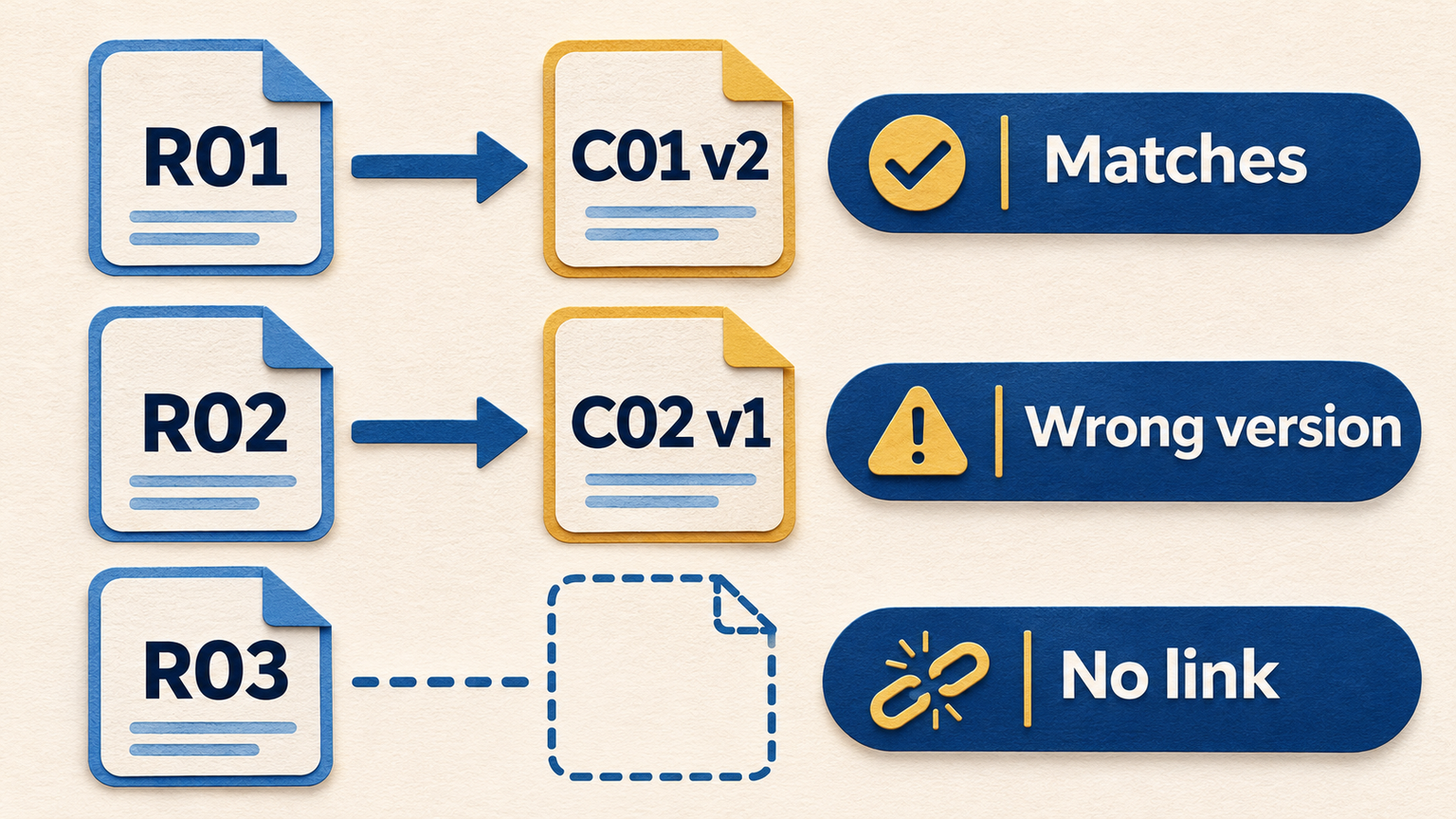
The R01 control matters: the comparison can recognise an applicable record, not merely reject every link. For R02, the matching page count and sizes are insufficient because the checked version differs. That is a limitation of the proposed evidence, not an observed defect in v2.
Do not attach C03 to R03 just because both mention the archive. C03 checks a licence note, while R03 concerns an editable poster source. Nor should C03 be deleted because it has no requirement link in this small set. Retain it and determine its purpose through the project’s actual records.
Finding an appropriate record elsewhere may resolve a gap. Until then, the accurate statement is that the provided links do not establish the requirement. It would be stronger, and unsupported, to say that no evidence exists anywhere.
Compare coverage with the baseline, not the number of PASS rows
The recorded checklist summary remains three PASS results out of three checks. The requirement-coverage result is different: one of the three baseline requirements has an applicable supplied link. R02 has an unsuitable proposed link, and R03 has none in the supplied set.
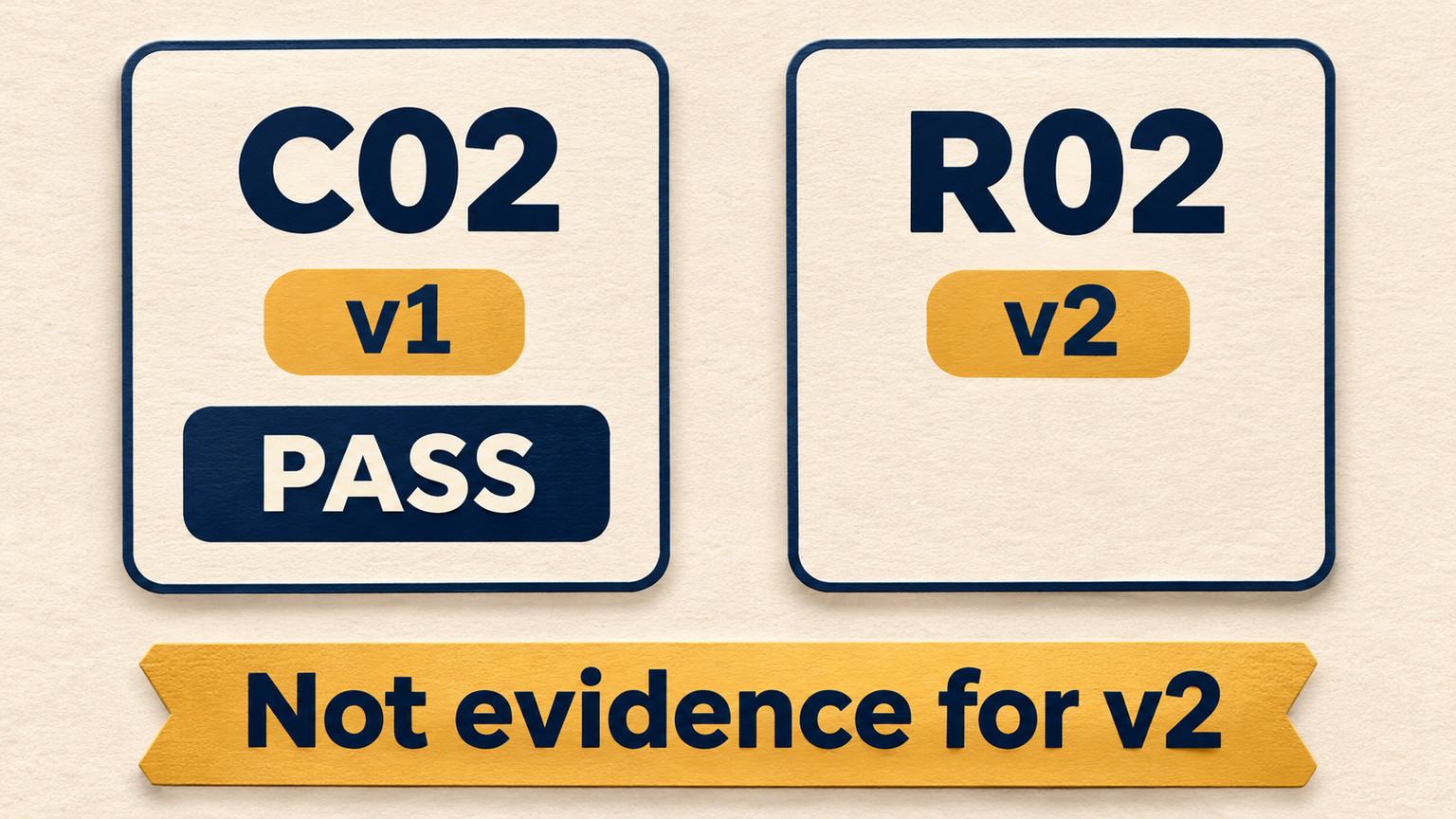
Equal counts are therefore not coverage. Follow each requirement from its agreed source to the claimed record, then read that record’s target, version, conditions and observations. Also inspect every proposed link and retain unmatched records. Counting only the links that worked would hide the remaining work.
A website launch checklist helps organise practical checks and handover. This matrix has a narrower, complementary job when the agreement includes specific requirements: reconcile those requirements with the evidence actually supplied. Do not create a second register merely to repeat a checklist’s rows or rename its statuses.
If an observed defect needs a remedy, follow that problem through the remedial work and outcome checks. Here, no v2 failure or missing source file has been observed. The immediate gap is what the proposed links establish, so the next action is to obtain or identify the appropriate evidence.
Hold the conclusion when the input set is uncertain
The complete example depends on explicit input boundaries. The following are separate incomplete variants, not changes to its original records.
| Variant | Missing information | Conclusion to hold |
|---|---|---|
| U-BASELINE | No confirmation that the known requirement rows are the complete agreed baseline | Do not conclude that the whole baseline is covered. Retain the known rows and confirm the complete scope. |
| U-VERSION | A record otherwise like C02 has no checked version supplied | Its applicability to v2 is unknown. Do not call it a proven v1 mismatch or a v2 failure. |
| U-SCOPE | A social-tile v2 record has a PASS label but no check scope or observation values | Do not infer that format and both dimensions were checked. Request the missing detail. |
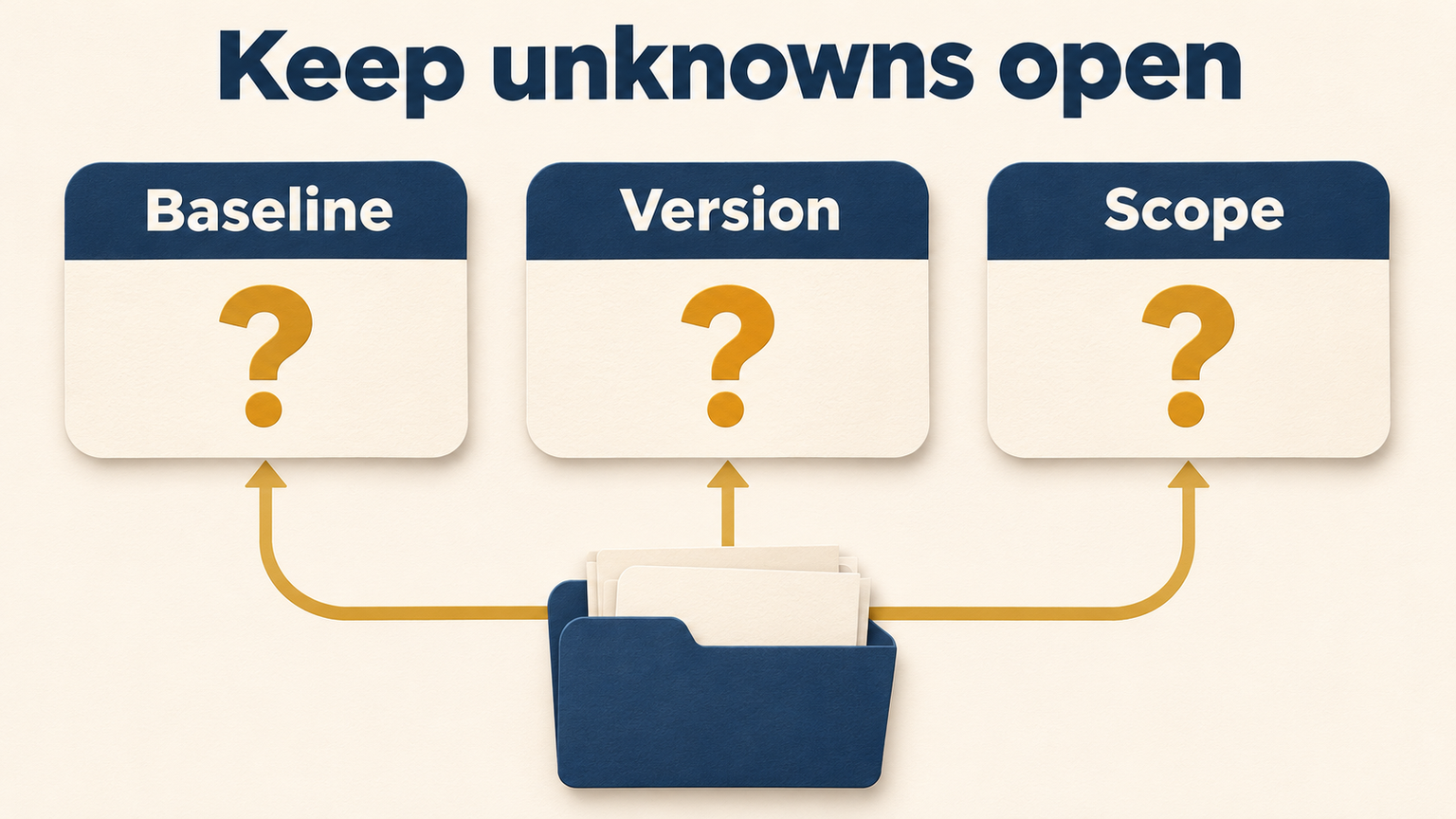
These uncertainties call for different information. A missing version needs the exact checked artifact; an incomplete baseline needs the agreed requirement set. Filling empty cells with defaults, or treating an unknown set as empty, would manufacture a conclusion.
The matrix also does not approve a change to the client’s requirements. If the agreed version or deliverable changes, record that decision through the project process and reassess affected links. Keep the earlier baseline and evidence so the previous conclusion remains understandable.
Hand over the gap and the next evidence needed
Use the fictional requirements baseline CSV, recorded evidence and proposed links CSV, coverage comparison CSV and handover notes to follow the example without running code. The notes explain the supplied records, the coverage conclusions and the incomplete variants.
The coverage CSV has one row for each of the three requirements. It includes the requirement wording and source clause, target and required version, proposed link, recorded result and version, conclusion, finding and next work, plus owner and evidence-location fields. Owner fields are blank in this fictional example; assign a person before handover. The example names fictional records, not real report locations, so replace the evidence-location text with the agreed report location for your job. The files contain plain values rather than formulas or automatic verification. Office or spreadsheet import has not been tested; inspect a copy before adapting them to live records.
For your own handover, record the requirement and source clause, the exact evidence location, what remains unresolved, and who will obtain the missing information. Specify the artifact version and conditions needed rather than asking someone to “finish verification”. A filename alone will not establish every property, including whether a delivered source is usable for the agreed editing work.
Start from the next delivery’s actual agreement and use only non-confidential material in a shared worksheet. TASKUL’s English product page is available if you are evaluating work-management tools. No automatic traceability, evidence assessment, client approval or publication workflow is demonstrated here.
Requirements traceability questions
Can every checklist row pass while requirements remain uncovered?
Yes, within this supplied example. All three recorded checks retain PASS, but only R01 has an applicable evidence link. C02 concerns the wrong leaflet version for R02, and no link is supplied for R03. Read the requirement-to-record relationships rather than equating the two row counts.
Does an unsuitable evidence link mean the deliverable failed?
No. C02 does not establish whether leaflet v2 meets its requirement because it records v1. Preserve the result it actually supports, identify the required evidence and avoid recording an unobserved failure or client rejection.
What if a requirement has no evidence link?
Record a traceability gap in the set you have reviewed, and identify the next source or check to obtain. Do not infer that the deliverable is missing or that no evidence exists elsewhere. If the requirement baseline or record scope is incomplete, keep that wider conclusion on hold too.