
There is no law in Australia that tells you what a freelance quote has to contain. What there are, are two rules that decide how you show the price, and one fact that most freelancers find out too late: once a client accepts your quote, it generally becomes a binding contract. So the document you send in four minutes is the document you are held to for the next two months.
This covers what to put in it, how GST changes depending on who you are quoting, and what has to happen to the same numbers when they turn into an invoice. It is general information about how the paperwork works, not legal or tax advice for your situation.
What should a freelance quote include?
The government’s own guidance, on the business.gov.au page for preparing quotes, is short: itemise the costs, give a total, and include GST where it applies. Everything past that is your choice, and the choices are what protect you.
A quote that holds up has nine parts:
| Part | What it does |
|---|---|
| Your name and ABN | Without an ABN the client generally has to withhold tax at the top rate |
| Client name and contact | Identifies who is accepting, which matters if the company has several entities |
| Date and a quote number | Lets you refer to “the quote dated the 3rd” instead of “the email I sent” |
| Itemised deliverables | Each line is countable and finishable, not an activity |
| What is not included | The half that prevents arguments later |
| Price, and how GST is shown | Depends on whether the client is a business or a consumer |
| Payment terms | Deposit, milestones, and how many days to pay |
| Validity period | Stops a quote from January being accepted in July |
| What a change costs | Sets the rate while the relationship is still warm |
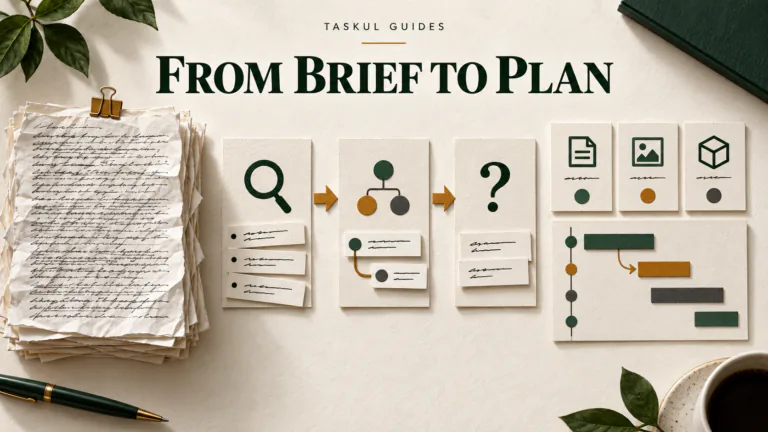
The itemised list is where quotes usually go wrong. “Website design” is one line and one argument waiting to happen. “Five page templates, one round of revisions each” is a line that can be counted by either of you without a conversation. Turning a vague brief into countable lines is its own job, and we go through it in how to turn a client brief into a project plan.
Do you show GST-inclusive or GST-exclusive prices?
This is the question that actually has a rule behind it, and the answer depends on who is reading the quote.
If you are quoting a consumer, the ACCC’s guidance on price displays is that businesses must display the total price as a single figure, including taxes and all unavoidable fees. A consumer quote showing “$2,000 + GST” is not a single total price.
If you are quoting another business, the same ACCC page says that where prices are displayed only to other businesses, GST does not have to be included in the total price. That is why “$2,000 plus GST” is normal in B2B work and looks wrong on a quote to a homeowner.
Two practical consequences:
- If you work for both, keep two quote formats rather than one compromise format. A single habit will be wrong for half your clients.
- If you are not registered for GST, do not put a GST line on the quote at all, and do not add 10% to the price. You are not collecting it.
When does GST start applying to your quotes?
Once your GST turnover reaches $75,000 you must register within 21 days, and the ATO measures that two ways: your current turnover, meaning this month plus the previous 11, and your projected turnover, meaning this month plus the next 11. Either one reaching the threshold triggers it. The detail is on the ATO’s registering for GST page.
The projected test is the one that catches freelancers, because signing one large retainer can put you over the line on the day you sign it, not at the end of the year. If a new client would do that, it belongs in the decision before you quote — see working out whether you can take on another client this month.
Deposits, milestones and terms
A deposit is not a sign of distrust, it is the thing that makes a project real. No rule sets the size of a deposit, so choose an amount that covers the time you are holding for the client. The useful framing when you write it is what it buys rather than what it protects: “A 40% deposit books the work into the week beginning the 6th.”
On anything longer than a few weeks, bill at milestones instead of at the end. Three payments of a third each mean a stalled project has already paid for the part you did, and a client who disappears in week six costs you two weeks instead of six.
State the payment period in days, and state it in the quote rather than only on the invoice: “Invoices are payable within 14 days.” If the client’s accounts team works to a longer cycle, that is a negotiation you can have once, at the quote stage, rather than discovering it when the first invoice ages.
For context on what the slower end of the market looks like, the Payment Times Reporting Regulator — which publishes what large Australian businesses actually do — reported in its July 2025 update that 74.7% of reporting entities had standard payment terms of 20 days or less and 90.2% of payments were made within 30 days. That scheme requires large businesses to report their payment performance; it is not a place to lodge a complaint about an unpaid invoice.
Put a validity period on it
“This quote is valid for 30 days” is one line and it does two jobs. It stops a client accepting an old price after your rates or your availability have changed, and it creates a reason to follow up that is not about chasing: “Just a note that this one expires on the 14th — happy to reissue if the timing has moved.”
Without it, every quote you have ever sent is technically still open, and the one that comes back is always the one you priced before you knew better.
What happens when the quote becomes an invoice?
This is where the rules get specific, because invoices are regulated and quotes are not.
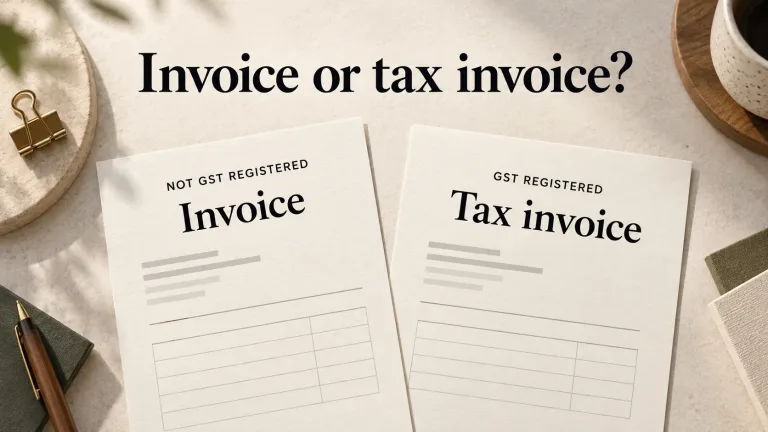
If you are registered for GST, your invoice is a tax invoice, and the ATO’s tax invoices page sets out what it has to show. For taxable sales under $1,000 it must include enough information to clearly determine seven things:
- That the document is intended to be a tax invoice
- The seller’s identity
- The seller’s ABN
- The date the invoice was issued
- A brief description of the items sold, including the quantity (if applicable) and the price
- The GST amount payable, if any — shown separately, or as a statement saying “Total price includes GST” where the GST is exactly one-eleventh of the total
- The extent to which each sale on the invoice is a taxable sale
For sales of $1,000 or more, the invoice also has to show the buyer’s identity or ABN. The ATO notes that an invoice meeting the $1,000-or-more requirements can be used for smaller amounts too, which is the simplest way to run it: build one template that always names the buyer, and stop thinking about the threshold.
Two timing rules on the same ATO page are worth knowing. If a customer asks for a tax invoice you must provide one within 28 days, unless the sale is $82.50 including GST or less. And a tax invoice does not have to be on paper — a PDF by email is fine, as long as it carries all the required information.
What if you are not registered for GST?
Then you are not making taxable sales, there is no GST to show, and the document is an invoice rather than a tax invoice. Leave the words “tax invoice” off it and leave GST off it. A sale is only a taxable sale if you are registered for GST or required to be, so a 10% line on an unregistered quote labels part of your price as GST when it is not. Watch the threshold instead: once you are required to register, the ATO says you may have to pay GST on sales made since that date, even if you didn’t include GST in the price.
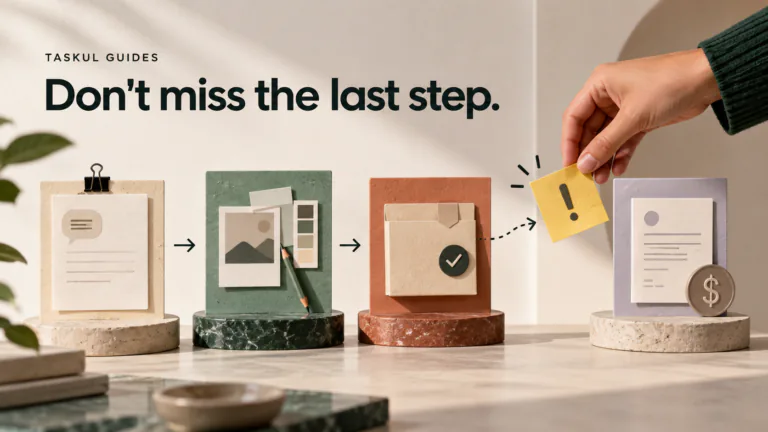
A quote is the first of several points where a job can quietly change shape. The freelance project checklist covers the later ones: the new request mid-project, the final review, the handover and the invoice.
The mistake that costs the most
It is not underpricing. It is sending a number without a scope, because a bare number invites the client to fill in the scope themselves, generously, in their own favour, without realising they are doing it.
The fix is one paragraph at the bottom of every quote:
“This covers the items listed above. Anything outside it I will quote separately and confirm in writing before starting. The delivery date assumes I have final copy and image files by the 9th.”
Three sentences. They set the boundary, promise no surprise billing, and hand back the part of the schedule that depends on the client. More on holding that line once work starts is in how to stop scope creep before it starts.
Frequently asked questions
Is a quote legally binding in Australia?
business.gov.au’s guidance on preparing quotes explains that a quote which the client accepts generally forms a legally binding contract. That is why the exclusions and the validity period matter more than the layout. If a specific job carries real risk, get advice on it rather than relying on a template.
What is the difference between a quote and an estimate?
A quote is a fixed price for a defined scope. An estimate is your best guess at what an undefined job will cost, and it is expected to change. Use the word you mean, and if you are giving an estimate, say what would make the final number move.
Do I need an ABN to send a quote?
Not to send the quote, but you want one before you invoice. Without an ABN on the invoice, a business paying you more than $75 excluding GST generally has to withhold tax at the top rate and send it to the ATO instead of to you, under the rule on withholding if an ABN is not provided. You also need an ABN before you can register for GST.
How long should a quote be?
One page for most freelance work. The quotes that lose jobs are the ones that read as a defensive document, full of conditions and no picture of what the client is getting. Lead with the deliverables and the date. Put the terms at the bottom, short and calm.
Should I put my hourly rate on a fixed-price quote?
Put the change rate on, not the rate you used to build the price. The client needs to know what an addition costs. Showing the working on a fixed price turns the conversation into a negotiation about how long things should take, which is not a conversation that ends well for the person doing the work.