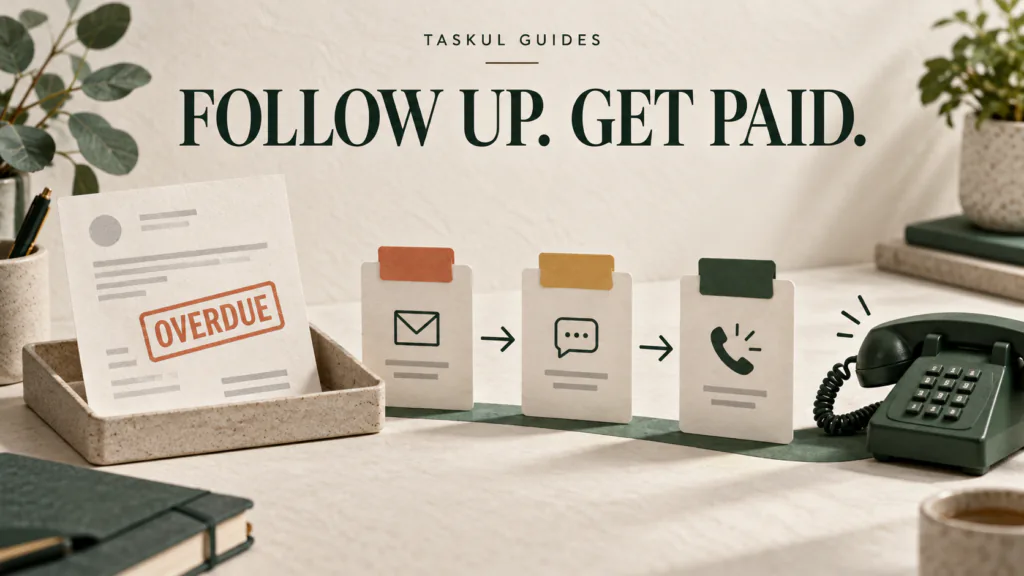
Most advice about chasing late payments is written for the United Kingdom or the United States, where the rules and the forums are different. In Australia, a freelancer chasing an unpaid invoice has a clear path: a scheduled reminder sequence, then a phone call, then a letter of demand, and if it still does not move, a claim in the court or tribunal that covers small debts in your state. The part that trips people up is that the right forum is not the same in every state, and in New South Wales the obvious-looking option is usually the wrong one.
This is general information about the process, not legal advice. If the amount is large, get advice before you lodge anything.
Set the chase up before the invoice is late
Almost everything that makes chasing hard is decided before the invoice is sent. Three things to have in place:
- Terms in days, agreed at quote stage. “Payable within 14 days” on the quote, not discovered on the invoice.
- The right entity, the right inbox, and a PO number if they need one. Invoices that go unpaid longest are often not disputed at all — they cannot travel through the client’s system. Collecting this is covered in client onboarding for freelancers.
- The follow-ups already scheduled as tasks, created the day you send the invoice, not the day you notice.
That last one changes the emotional register of the whole thing. A reminder that fires on a date is routine. A reminder you send because you are annoyed reads like it.
The sequence that works
Day 0 — the invoice
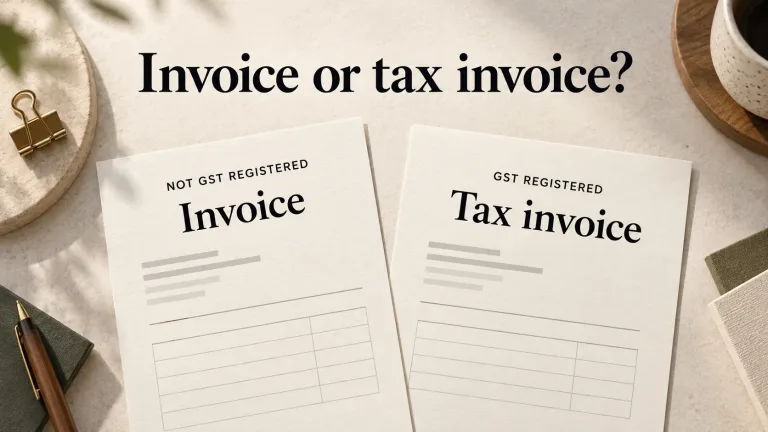
Send it on the delivery date, not at the end of the month. If you are registered for GST it is a tax invoice, and it has to carry the seven details the ATO lists on its tax invoices page, plus the buyer’s identity or ABN for sales of $1,000 or more. An invoice missing a required detail gives an accounts team a legitimate reason to send it back, and that costs you a full cycle.
Terms + 1 day — the first reminder
Short, neutral, no apology. “Hi Sam, invoice 0142 for $2,400 was due yesterday. Could you let me know when it is scheduled for payment? Copy attached.” Send it to the accounts address and copy your day-to-day contact. The second part matters, because your contact usually has more influence over accounts than you do.
Terms + 7 days — the second reminder
Same tone, one addition: ask a question that needs an answer rather than a payment. “Has this one been approved for payment, or is something missing from my end?” You are giving them a way to tell you it is stuck, which is usually what has happened.
Terms + 14 days — pick up the phone
This is the step freelancers skip and it is the one that works. Email is easy to defer; a call is not. Ring accounts, ask what the status is, ask for a date, and then send a one-line email confirming what they said. That email is now your record.
Terms + 21 to 30 days — the letter of demand
A letter of demand is a formal written request for payment, setting out what is owed, what it is for, and a deadline. business.gov.au’s page on writing a letter of demand frames it as something you “may wish to send” — it is not a legally required step before going to court, but it does two useful things. It often works on its own, because it signals you are prepared to escalate, and if you do end up making a claim, it shows you tried to resolve the matter first.
Keep it factual. Invoice number, amount, what it was for, when it was due, what you have already sent, and a date by which you expect payment.
Where do you take it if that fails?
Here is where the state you are in decides what happens next. These are the small-claims paths for a debt, with the figures published by each court or tribunal. Limits change, so check the current figure on the page before you lodge.
| State | Where an unpaid invoice goes | Limit |
|---|---|---|
| NSW | Local Court — Small Claims Division | Up to $20,000, and the General Division above that to $100,000 |
| VIC | VCAT Civil Claims List | Check the current threshold; larger claims go to the Magistrates’ or County Court |
| QLD | QCAT minor debt dispute | Up to $25,000, excluding interest |
| WA | Magistrates Court minor case claim | Up to $10,000, with general procedure claims above that |
| SA | Magistrates Court minor civil action | Up to $12,000, with general claims above that |
The New South Wales trap
NCAT hears consumer claims up to $100,000, and because that number is large and the process is cheap, it is the one people find first. But that jurisdiction is built around claims made by a consumer about goods or services they bought. A freelancer chasing a business client for an unpaid invoice is on the supplier side of that relationship, which generally makes it a matter for the Local Court instead.
Check which one fits your situation before lodging anything. Filing in the wrong forum costs you the fee, the time, and the momentum you built with the letter of demand.
Most invoices are late because nobody set the follow-up on the day the invoice went out. The freelance project checklist puts that follow-up in the same list as the rest of the job, so it stops being something you have to remember.
Can you charge interest or recovery costs?
This comes down to what you agreed. If your terms include a late-payment clause with a stated interest rate, you have something to point to. If they do not, do not assume you can add interest to the invoice after the fact — adding a charge nobody agreed to gives a slow payer a reason to dispute the whole invoice rather than pay the original amount.
The practical move is to fix it forward. Put a short late-payment clause in your terms for the next job, and get advice if an existing debt is large enough to matter. Where the clause belongs is covered in how to write a quote for freelance work in Australia.
What about the Payment Times Reporting Scheme?
It is worth knowing what this is so you do not waste time on it. The scheme requires large Australian businesses to report their payment terms and how quickly they actually pay, and it publishes that on a public register. It is a transparency measure — it does not set payment terms for large businesses, and it is not somewhere you lodge a complaint about your own unpaid invoice.
It is still useful before you sign. If you are about to take on a large client, their payment record is public on the Payment Times register, and it is a better predictor than anything they tell you in the kickoff call.
Stop work, or keep going?
If an invoice is well past terms and more work is scheduled, pausing is reasonable and you should say so in advance rather than silently slowing down. One line, no ultimatum: “I’ll hold the next stage until 0142 is settled — let me know once it’s scheduled and I’ll pick it straight back up.”
Check what your quote says about it first. If it says nothing, that is the clause to add next time, which is one of several reasons the quote is the document that decides how the rest of the job goes.
Frequently asked questions
How long should I wait before chasing an invoice?
One day past terms. Waiting a polite fortnight teaches the client that your terms are a suggestion, and it means the first time you raise it you are already annoyed. A same-week reminder is normal business practice and nobody takes offence at it.
Do I need a letter of demand before going to court?
It is not a required step — business.gov.au describes it as something you may wish to send. It often resolves things on its own, and if you do lodge a claim it shows you tried to sort it out first.
Should I use a debt collector?
For a single freelance invoice, usually not. Collectors take a percentage or a fee, and the step that actually moves most stuck invoices is the phone call you have not made yet. Consider it for genuinely abandoned debts where you have exhausted the sequence.
What if the client says the work was not up to standard?
That is a dispute, not a late payment, and it is handled differently. Go back to the written scope and ask specifically what does not match it. Vague dissatisfaction that appears only after an invoice is usually about the invoice. A specific complaint that matches the scope is worth fixing quickly and without argument.
How do I keep this from happening again?
Take a deposit, bill at milestones on longer jobs, confirm the accounts process during onboarding, and schedule the follow-ups on the day you invoice. Four habits, none of which take more than a minute, and together they remove most of the situations where you end up reading a page like this one.