
Most explanations of freelancer, sole trader and independent contractor treat them as three things you choose between. They are not. In Australia they describe three different dimensions of the same working life, and a typical freelancer is all three at once: a freelancer by occupation, a sole trader by business structure, and an independent contractor in relation to each client who hires them.
What is worth your attention is not the definitions. It is the two distinctions underneath them that genuinely change how you quote, what you put on an invoice, and whether someone owes you superannuation.
What do the three words actually describe?
| Word | What it describes | Who decides it |
|---|---|---|
| Freelancer | How you work: short engagements, several clients, no single employer | You, informally. It has no status in tax law |
| Sole trader | Your business structure, as opposed to a company, partnership or trust | You, when you set the business up |
| Independent contractor | Your relationship with a particular client on a particular engagement | The substance of the arrangement, not the label on it |
The third row is the one that surprises people. Whether an engagement is a contractor relationship is not settled by calling it one, and it can differ from client to client while your business structure stays exactly the same.
Distinction 1: are you paid for a result, or for your labour?
This is the most useful line in the whole subject, because it has consequences you can see in your bank account.
The ATO’s page on super for independent contractors sets out that if a client pays you mainly for your labour, you are an employee for superannuation guarantee purposes and they may have to pay super for you. Three things together trigger it: the contract is mainly for your labour, meaning more than half its dollar value; payment is for your personal labour and skills rather than for achieving a specified result; and you have to do the work yourself rather than being able to delegate it.
The ATO is explicit that having an ABN does not change this.
Its own contrasting example is a painting business contracted to paint a shop. The client paid for a result, so there is no super obligation, and that holds even if the painter is a sole trader doing the job personally. The difference is not the structure. It is what was bought.
What this means on a Tuesday
- If you are sitting with one client for fifteen hours a week, invoicing hours, and the arrangement requires you personally, that looks much more like the labour side. It is worth raising at the start.
- If you quote projects for a defined deliverable and could in principle bring in help, that is the result side.
- The ATO also notes, on the same super for independent contractors page, that paying you an extra amount on top of your usual pay instead of making a super contribution does not count. It has to go to your super fund.
The same distinction shows up in how you should price the work, which is covered in how much to charge as a freelancer in Australia.
Distinction 2: sole trader or company?
This is the structure decision, and it is the one an accountant should make with you rather than an article. What is worth knowing before that conversation is what changes.
As a sole trader, the business and you are the same legal person. Your business income is your income and goes in your individual tax return. The ATO’s income tax return guidance is clear that a sole trader must lodge a return even if income is below the tax-free threshold, and that there is no threshold for business income. If you lodge it yourself it is due by 31 October. If you lodge through a registered tax agent, they will tell you when they will lodge it.
Through a company, the business is a separate legal entity with its own tax return and its own obligations, and your relationship to it changes. It costs more to run and it exists for reasons — liability, clients who will only contract with companies, how income is handled — that are specific to your situation.
What does not change between the three
Whatever you call yourself, the same things are true in Australia:
- The financial year runs 1 July to 30 June. Your quoting, your records and your invoice chasing all sit inside that cycle.
- You need an ABN in practice. Without one on your invoice, a business paying you more than $75 excluding GST generally has to withhold tax at the top rate and send it to the ATO instead of to you, under the rule on withholding if an ABN is not provided. You also need one before you can register for GST.
- The GST threshold is $75,000 of GST turnover. You reach it if your turnover for the current month and the previous 11 months is $75,000 or more, or if your turnover for the current month and the next 11 months is likely to be. Once you are required to register, you have 21 days to do it, under the ATO’s rules on registering for GST.
- Nobody gives you leave. The weeks you take off are weeks you do not bill, which is why they belong in your rate rather than in your regrets.
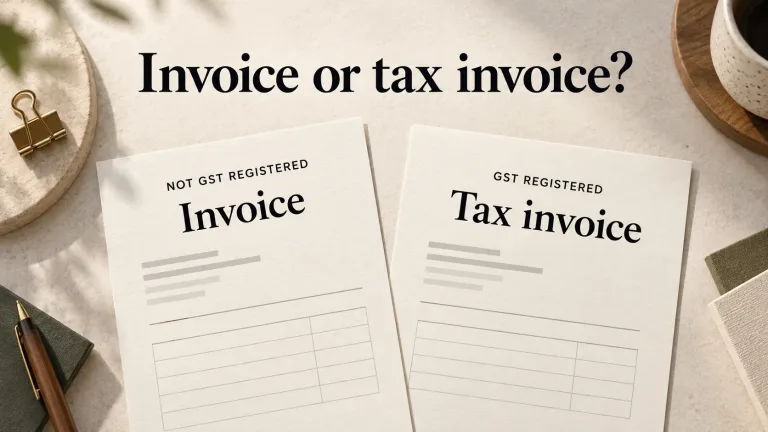
- Your invoices have rules. If you are registered for GST, the ATO’s tax invoices requirements apply, including the buyer’s identity or ABN once a sale reaches $1,000.
How to describe yourself to clients
Use “freelance” or your craft when you are selling, because that is how clients search and how they think. Use “sole trader” on anything to do with tax or structure. Use the entity name and ABN exactly as registered on quotes and invoices, because that is what their accounts system matches against.
The last point causes more late payments than it should. An invoice made out to a trading name when the client’s system only knows the registered entity will sit in someone’s queue without anybody telling you. Collecting the right details at the start is covered in client onboarding for freelancers.
If a client wants to call you an employee, or an employee an independent contractor
Labels applied to an arrangement do not decide its substance. If someone proposes a contractor arrangement that in practice looks like employment — set hours, your personal work, direction over how you do it, no ability to delegate — that is worth getting advice on rather than accepting because of what the document is called. The ATO’s employee-or-contractor guidance is the starting point. It says that any label the two sides use in the contract, such as “independent contractor”, will not determine how the relationship is characterised. It is written from the payer’s side, which makes it useful reading for the other side of the table.
None of this is legal advice. It is the shape of the questions worth asking before you sign something.
Frequently asked questions
Can I be a sole trader and a contractor at the same time?
Yes, and most Australian freelancers are. Sole trader describes your business structure. Independent contractor describes your relationship with a particular client. You can be a sole trader working as a contractor for four clients at once.
Does calling myself a freelancer have any legal meaning?
No. It is an occupational description with no status in Australian tax or business law. What matters on the paperwork is your business structure, your ABN, and whether you are registered for GST.
Do I need to register a business name?
It depends on the name you trade under rather than on the kind of work you do, and ASIC is the registrar, so check the current position on ASIC’s business names pages before you print anything. What matters either way is that your quotes and invoices carry the details exactly as registered, because that is what a client’s accounts system matches against.
When should I move from sole trader to a company?
It is an accountant’s question, and the honest triggers are usually liability exposure, clients who will not contract with an individual, and income reaching a level where the structure changes the outcome. Moving because it sounds more professional costs money every year and changes nothing a client can see.
Can a client refuse to pay super they owe me?
If the super guarantee applies to the arrangement, it is an obligation, and the ATO’s page on super for independent contractors sets out when it does. Raise it in writing early rather than at the end of a year. If it is disputed, that is a matter to take to the ATO rather than to argue out over email.