

Here is the fact that catches out more Australian freelancers than any other rule in this area. If half your income comes from overseas clients, those sales are almost certainly GST-free — and they still count towards the $75,000 threshold that forces you to register for GST. The ATO’s own worked example is a business with $50,000 of Australian sales and $50,000 of overseas sales, and the conclusion is blunt: “Alex’s GST turnover is his total sales of $100,000 so he must register for GST.”
Plenty of people read “my overseas work is GST-free” and conclude it is invisible. It is not. It is GST-free at the invoice and fully counted at the threshold. This guide covers where the line actually sits, what changes when you cross it, and the one case where registering early is worth doing on purpose. It is general information rather than tax advice, and the ATO pages linked throughout are the authority.
What GST is, in the two sentences that matter
The ATO describes GST as “a broad-based tax of 10% on most goods, services and other items sold or consumed in Australia”. If you are registered, you add 10% to your taxable sales, collect it on the ATO’s behalf, and claim back the GST included in your business purchases.
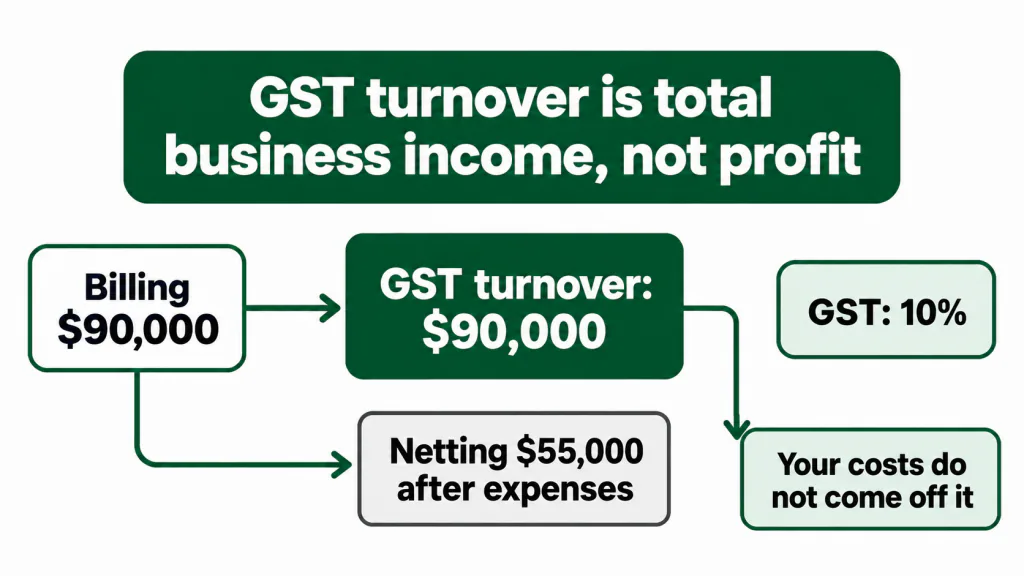
The word doing the most work is turnover. GST turnover is total business income, not profit. The ATO defines it as your total business income minus GST included in sales, sales to associates that are not for payment, sales not connected with an enterprise you run, input-taxed sales, and sales not connected with Australia. Your costs do not come off it. A freelancer billing $90,000 and netting $55,000 after expenses has a GST turnover of $90,000.
The $75,000 test, in both directions
The ATO’s registration guidance says you must register when your enterprise “has a GST turnover (gross income from all businesses minus GST) of $75,000 or more (the GST threshold)”, or when you start a new business and expect to reach the threshold in the first year. For not-for-profits the figure is $150,000.
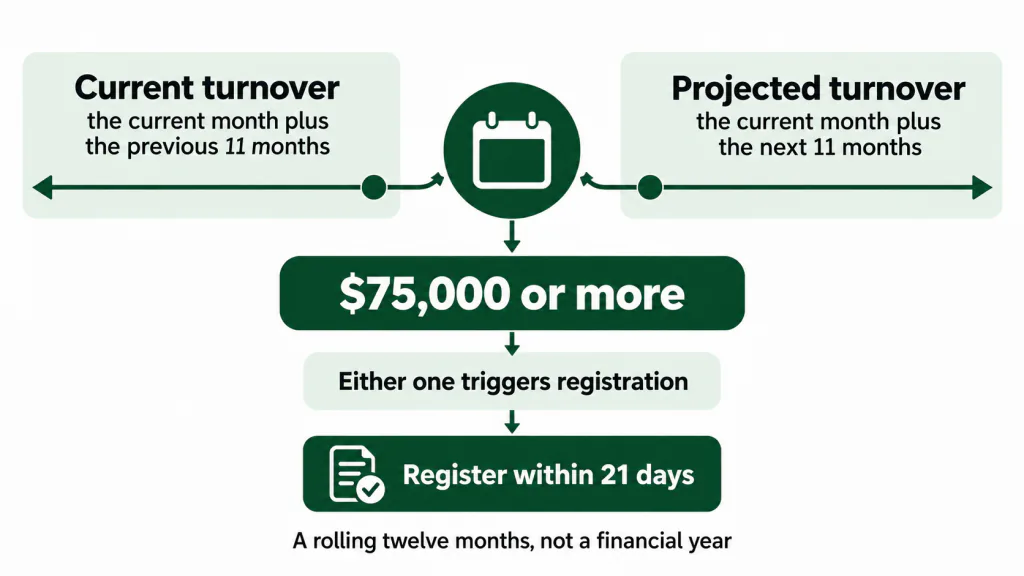
The test runs on two clocks, and either one triggers registration:
- Current turnover — the current month plus the previous 11 months totals $75,000 or more.
- Projected turnover — the current month plus the next 11 months is likely to be $75,000 or more.
That is a rolling twelve months, not a financial year. A quiet first half followed by one large project can put you over in March, and the financial-year figure at 30 June may never show it. The ATO’s advice for anyone under the threshold is to “check each month to see if you’ve reached the GST threshold, or are likely to exceed it”.
Once you are required to register, “you need to do so within 21 days”. Two more points from the same registration page: you need an ABN before you can register for GST, and there are activities where registration is required regardless of turnover — taxi and limousine travel including ride-sourcing, and claiming fuel tax credits.
Turnover works in your favour in one specific case. Even if your current turnover is at or above the threshold, you do not have to register if the ATO is satisfied your projected turnover will be under it, according to its turnover guidance. That covers the freelancer who had one exceptional year and is winding back, not the one hoping it will be quiet.
Overseas clients: GST-free at the invoice, counted at the threshold
This is where the real money is for a lot of freelancers, and where the rules deserve care.
The ATO’s position on exports is that “Exports of goods and services from Australia are generally GST-free”, and for services it gives two routes. One is where the “recipient of the service is outside Australia, and use of the service is outside of Australia.” The other is where “the supply is used or enjoyed outside Australia or the supply is made to a non-resident who is not in Australia when the supply is made.” The worked example is close to home for anyone reading this — a GST-registered Australian freelance writer engaged by an English company to write a chapter published in England, who “does not include GST in his invoice to the publisher”.
Note what is not enough. The ATO also states that “the supply of service is not GST-free if the service is provided in Australia even if the recipient is not in Australia”, and illustrates it with an Australian school teaching students who are physically in Australia while billing their overseas parents. Being paid from abroad does not make the supply an export. Where the work is done matters less than where the client is and where the service is used, and the ATO notes there are specific rules that decide what qualifies.
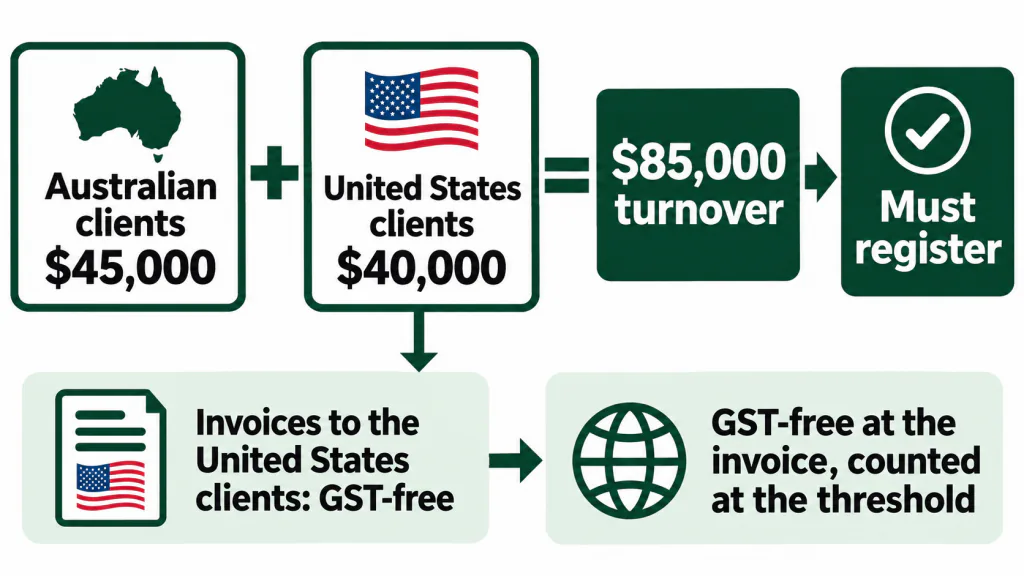
Then the part almost nobody plans for. From the same page: “When you calculate your GST turnover, you need to include export sales connected with Australia, even though they are GST-free.” So the freelancer with $45,000 of Australian clients and $40,000 of United States clients is at $85,000 turnover and must register, while continuing to issue GST-free invoices to the American half.
There is a real upside to being registered in that position. Your export sales carry no GST, but the ATO confirms you can still claim credits for the GST in the purchases you use to produce them — software, hardware, a co-working desk, an accountant. A freelancer whose income is mostly export and whose costs are mostly Australian can end up in refund territory rather than owing anything.
If your income comes through a platform rather than direct invoices, the ATO’s social-media example is the one to read. It turns on whether you can establish each buyer’s location: sales to offshore subscribers are GST-free and sales to Australian subscribers are taxable, and “if she can’t obtain the location of each subscriber, all her sales will be taxable”. Whether your platform gives you that data is worth checking before you assume the favourable treatment.
Registering before you have to
Below the threshold, registering is optional. It is occasionally the right call and usually not, and the trade-off depends almost entirely on who your clients are.
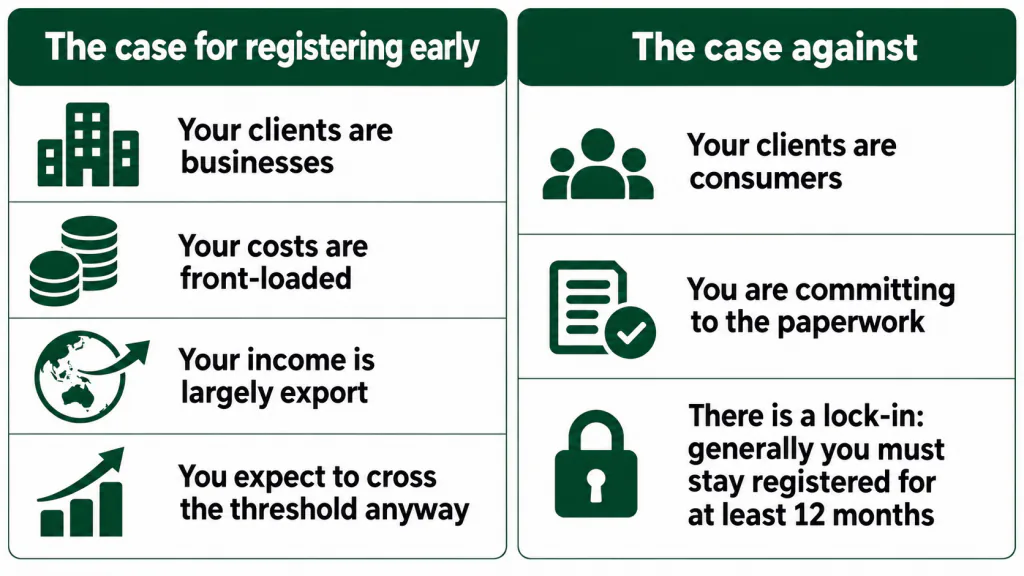
The case for registering early:
- Your clients are businesses. They claim your GST back, so a 10% addition costs them nothing in real terms. Meanwhile you start claiming credits on your own purchases.
- Your costs are front-loaded. If you are buying equipment to start, the GST in those purchases is recoverable once registered and lost if not.
- Your income is largely export. GST-free sales out, recoverable GST on Australian costs in.
- You expect to cross the threshold anyway. Registering on your own schedule beats doing it in a 21-day window during a busy month.
The case against:
- Your clients are consumers. Individuals cannot claim GST back, so either your prices rise 10% or you absorb it out of your own margin.
- You are committing to the paperwork. Registration brings activity statements and the record keeping behind them.
- There is a lock-in. The ATO states that if you choose to register, “generally you must stay registered for at least 12 months”.
One genuine benefit of voluntary registration is rarely mentioned. If you are voluntarily registered and your turnover is under $75,000, you can lodge annually rather than quarterly — the ATO lists both conditions for annual reporting, and it is once a year instead of four times. That is a materially lighter obligation than most people assume registration means.
What changes on your invoices
Once registered, the document you issue for taxable sales is a tax invoice, and the ATO sets out what it must contain. Below $1,000 it needs enough information to identify seven details. If the GST is exactly one-eleventh of the total, you can show it with the statement “Total price includes GST” instead of a separate amount. At $1,000 or more it also has to show the buyer’s identity or ABN. If a customer asks for a tax invoice, you must provide one within 28 days, unless the sale is $82.50 (including GST) or less. How the same numbers move from a quote to an invoice is covered in what to include in a freelance quote. The full invoice checklist, including what happens when a client issues the invoice for you, is in what to put on a freelance invoice in Australia.
Your ABN belongs on the document either way. Without it, an Australian business paying you more than $75 excluding GST has to withhold 47% — see do I need an ABN to freelance in Australia.
If your rates were set before registration, decide deliberately whether GST goes on top of your current number or comes out of it, and say which in the quote. Discovering the question at invoice stage means you are effectively negotiating a 10% discount with yourself. Setting freelance rates covers where GST sits in the pricing conversation.
Activity statements and the dates they fall on
Registration brings a business activity statement. Which cycle you are on depends on turnover, and for a freelancer it will almost always be quarterly or annual.
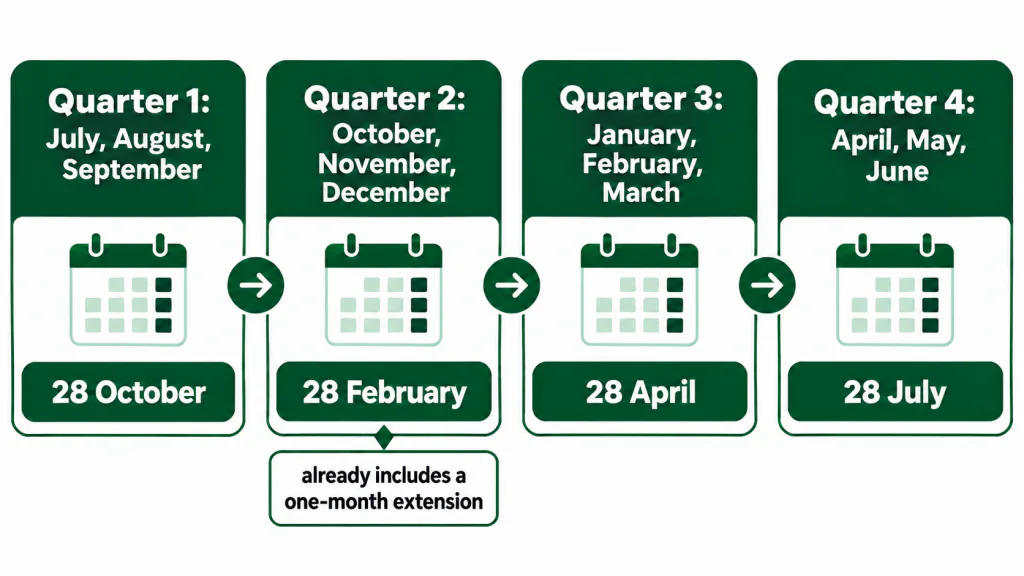
| Quarter | Period | Due date |
|---|---|---|
| 1 | July, August, September | 28 October |
| 2 | October, November, December | 28 February |
| 3 | January, February, March | 28 April |
| 4 | April, May, June | 28 July |
Those dates are from the ATO’s BAS due dates page. Lodging online may get you an extra two weeks, with one exception the page calls out specifically: “a later lodgment and payment due date does not apply for quarter 2 because the due date already includes a one-month extension.” Quarter 2 already has the Christmas allowance built in, which is exactly the quarter people assume they have extra time on.
On the same due dates page, monthly lodgement is compulsory at $20 million turnover or if the ATO directs it, and optional below that — the due date is the 21st of the following month. Annual reporting requires both voluntary registration and turnover under $75,000, and the annual GST return is due 31 October, or 28 February if you are not required to lodge a tax return by then. If a due date lands on a weekend or public holiday, you have until the next business day.
The practical point: quarterly GST is not a bill that arrives. It is money you have already collected and are holding. Treating the GST portion of every payment as not yours from the moment it lands is the habit that prevents the February problem.
If you should have registered and did not
The ATO is direct about this. If you do not register when required, “you may have to pay GST on sales made since the date you were required to register. This could happen even if you didn’t include GST in the price of those sales. You may also have to pay penalties and interest.”
Read that carefully. The liability is not reduced by the fact that you never charged it. If you crossed the threshold in October and registered the following July, the GST on nine months of invoices is owed out of money you already spent, unless you can go back to those clients — which for consumer work you generally cannot.
Backdating is possible and bounded: “Backdating a GST registration is limited to 4 years”, and you request it by phone. But the reason to check your rolling twelve months monthly is precisely to never need that conversation.
What to do this week
- Add up the last twelve months of invoiced income, including overseas clients. Not the financial year. Not profit. Total invoiced, rolling.
- Project the next twelve from work already booked. If either number is near $75,000, you are in the zone where the 21-day clock can start without warning.
- Put a recurring monthly reminder on that calculation. One figure, once a month. This is the entire compliance obligation while you are under the threshold.
- If your work is mostly export, price out voluntary registration properly. GST-free sales plus recoverable GST on Australian costs can be worth more than the paperwork, and annual lodgement is available while you are under the threshold.
- Decide now whether GST goes on top of your rate or inside it, and write it into your quote template before the question is live.
If any of this is close to the line, or your overseas work is structured through a platform or an agency, this is the point to pay a registered tax agent for an hour. The rules on when a supply is GST-free are more specific than a guide can responsibly compress, and getting the export treatment wrong runs in both directions.