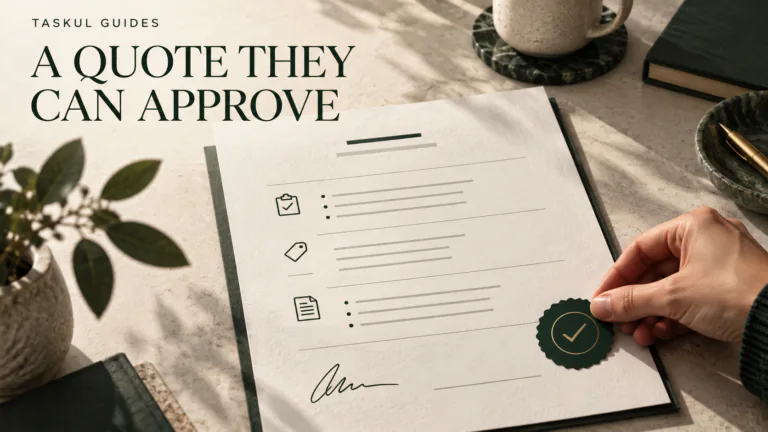

A scope of work template for creative jobs should answer the questions that cause arguments later: exactly what you will deliver, what is not included, what the client supplies and by when, how many rounds of changes are included, and what “finished” means. The free template below covers those in 12 short sections. It comes as a blank Word file, a filled-in example (a fictional café job) and a plain-text copy you can paste into Google Docs or an email.
It is written for freelance designers, web designers, video makers and small studios in Australia, for the step after the client has agreed to your quote. It is not a construction “scope of works”. Most scope of work templates online are built for building projects or for project managers inside large companies. This one uses the words a café owner or a tradie can read and sign without a meeting.
Download the scope of work template
All three files are free and need no sign-up:
- Blank scope of work template (Word, A4). Replace the words in square brackets with your details, delete anything that does not apply, then delete the first line.
- Filled-in example (Word, A4). A fictional café reopening, carried on from the example in our creative brief template.
- Plain-text version. The same sections without formatting, for pasting into a Google Doc or the body of an email.
The example is made up. The café, studio, people, ABNs, dates and amounts in it do not belong to a real business. The quotes from business.gov.au below were checked against their pages on 15 October 2026. This guide and the template are general information, not legal advice.
Where does a scope of work fit in a creative job?
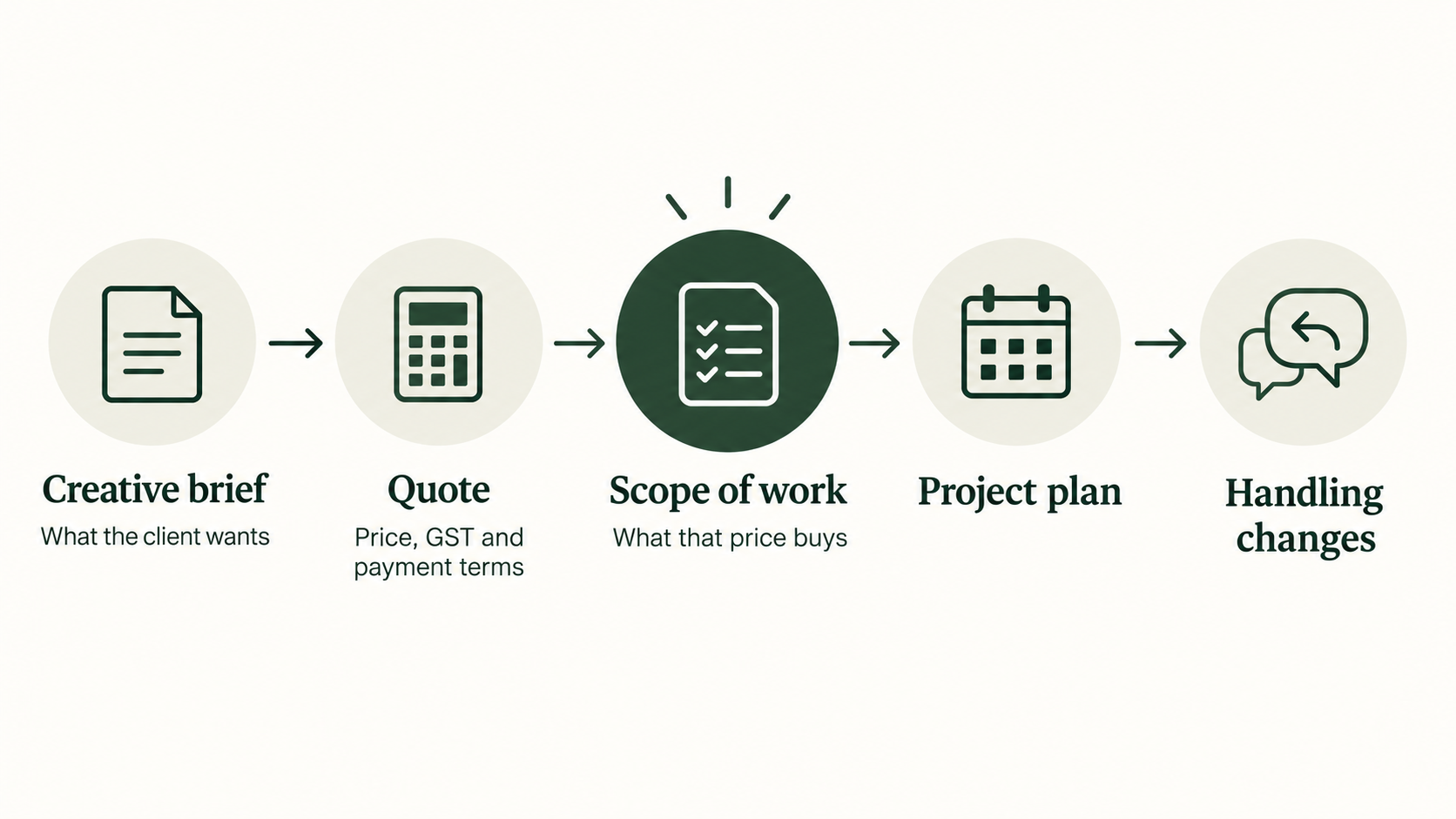
A small creative job usually produces three documents before work starts. Each one has a different job:
- The brief collects what the client wants, in their words. Our creative brief template is a questionnaire the client fills in before you quote.
- The quote sets the price, GST and payment terms. Our freelance quote guide for Australia covers what to put in it.
- The scope of work fixes what that price buys: the items, the limits, who does what by when, and how changes are handled.
You can put all of this in one long quote. Many freelancers do. The reason to split it is that the quote is about money and the scope is about the work, and it is the work that clients question halfway through the job. A separate one- or two-page scope is easier to point to than paragraph nine of a quote.
The two documents should not repeat each other. This template has one line for the price, which points to the quote by number and date. If the price or payment terms change, you only update the quote.
What goes in a scope of work for creative work?
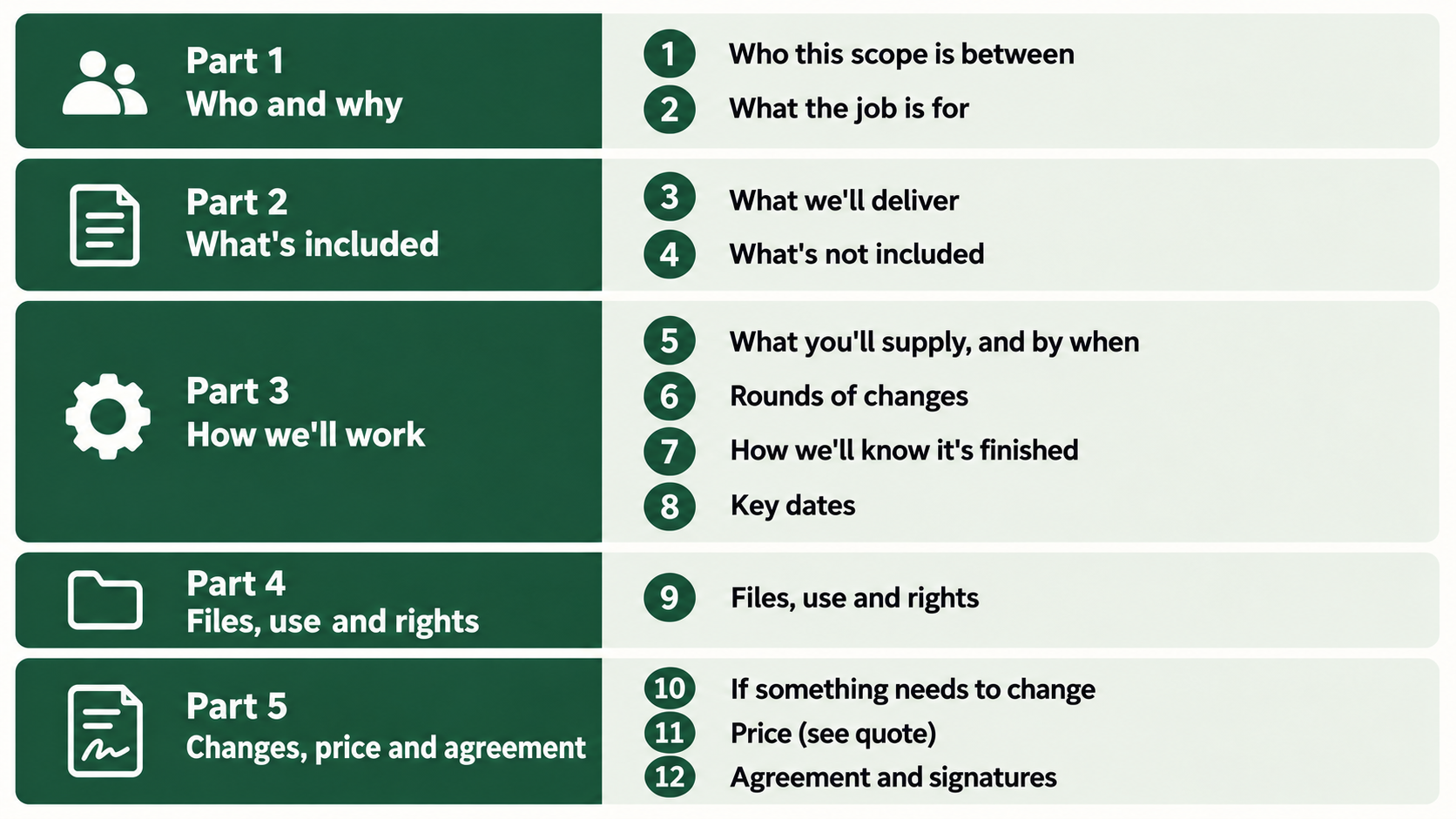
The template has five parts and 12 sections:
- Who and why (sections 1–2): both businesses’ details, the version number, and what the job is for.
- What’s included (3–4): what you will deliver, and what is not included.
- How we’ll work (5–8): what the client supplies and by when, rounds of changes, how you will both know it is finished, and key dates.
- Files, use and rights (9): which files the client gets, who owns the final design, and who pays for photo or font licences.
- Changes, price and agreement (10–12): the steps for a change, a pointer to the quote, and signatures.
The general advice on business.gov.au, the Australian Government’s business site, is that a simple contract covers four things: what work the contractor will do or results they will achieve
, how much and when the hirer will pay, what the contractor must do for the hirer to consider the work finished, and how disputes will be handled (business.gov.au: Prepare a contract). The first three map onto sections 3–8 and 11 of the template. Disputes are left out on purpose: for a job this size, you can add your own clause or keep it in your standard terms.
Three of the sections are what most scope of work templates miss for creative work: a count of rounds of changes, a dated list of what the client supplies, and who gets the editable files. These are the sections that cause most disagreements on design and content jobs, so the next part spends the most time on them.
How do you fill in each section?
Each section in the template has a “Why” line under the heading. It is written for the client, so they know why you are asking. The notes below are for you.
1–2. Who it is between, and what the job is for
Use each business’s full name and contact details, and both ABNs if you need them (see ABN for freelancers). Business.gov.au lists Include both parties’ details
as the first step of a contract. Give the scope a version number and date. When the client asks for a change before signing, send v2, not an edited v1 with no date.
For “what the job is for”, write two or three sentences. If the client filled in a brief, use their words. “Bring locals in during reopening week” gives you something to come back to when a request does not fit.
3. What you will deliver
Write each item so it can be counted: what it is, how many, what size, which file types and how it will be handed over. “Social media graphics” cannot be counted. “6 square Instagram posts, each with a matching story size, PNG files” can. Our guide to turning a client brief into a project plan has more examples of deliverables you can count.
4. What is not included
List what someone could easily assume is part of the job: printing, photography, writing the wording, posting to social media, website changes. Write them as plain facts, not warnings. The list in how to stop scope creep gives five common exclusions and how to word them.
5. What the client supplies, and by when
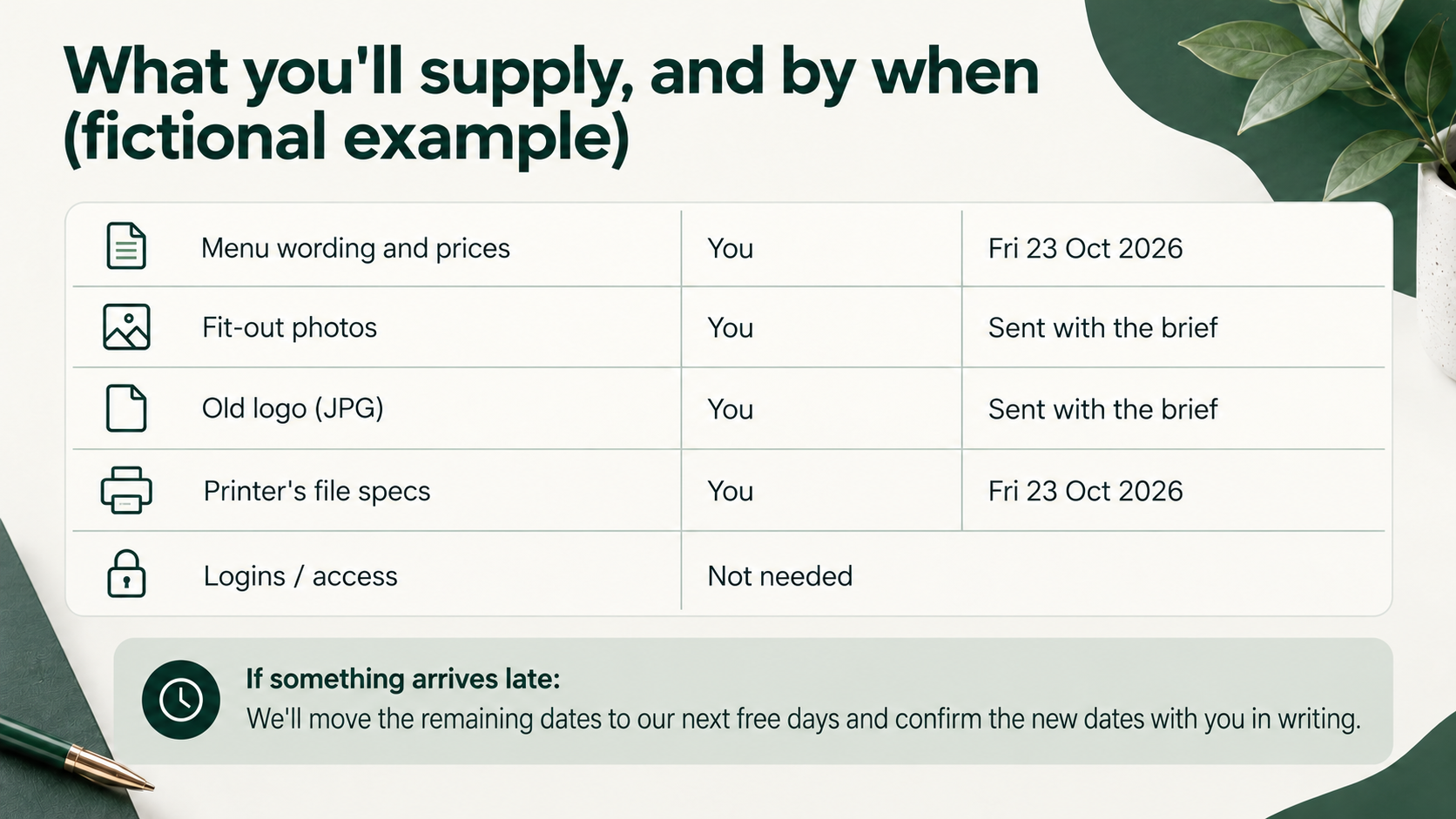
This is the section that protects your dates. Each line is one item (wording, photos, logo files, logins), marked “You” or “Us”, with a date. Under the list is one line for what happens if something arrives late. The example uses: We’ll move the remaining dates to our next free days and confirm the new dates with you in writing.
Agree this before the job starts, when nobody is late yet. If you only raise it when the menu wording is a week overdue, it reads as an excuse.
6. Rounds of changes
Write how many rounds are included, how fast the client will send feedback, and what happens with extra rounds. The template also defines a round: One round means one consolidated set of feedback, sent once. Without that sentence, five emails from three people can each count as a round.
The template does not suggest a number of rounds. That depends on the work and your price. The Australian Graphic Design Association’s proposal template advises designers to Clarify what’s included in the scope (e.g., revisions) and any extras that might incur additional costs (e.g., additional design rounds, licensing fees).
(AGDA Pitching Template, PDF).
7. How you will both know it is finished
Write something you can both check, such as “final files for all four items are in the shared folder and the owner has replied ‘approved’ by email”. Name one person who gives the final OK. Business.gov.au says a simple contract should set out the conditions the contractor must meet for the hirer to consider the contract finished
.
Some templates add a line such as “if we hear nothing within five days, the work is accepted”. This template does not, because whether that line works depends on your contract and the facts. If you want one, ask a lawyer.
8. Key dates
Four dates: work starts, first drafts, final OK and final files. Each has a reason and a “can it move?” box. A date tied to a printer’s deadline or an opening day cannot move. A date picked because it sounded reasonable usually can, and the box lets the client tell you which is which.
9. Files, use and rights
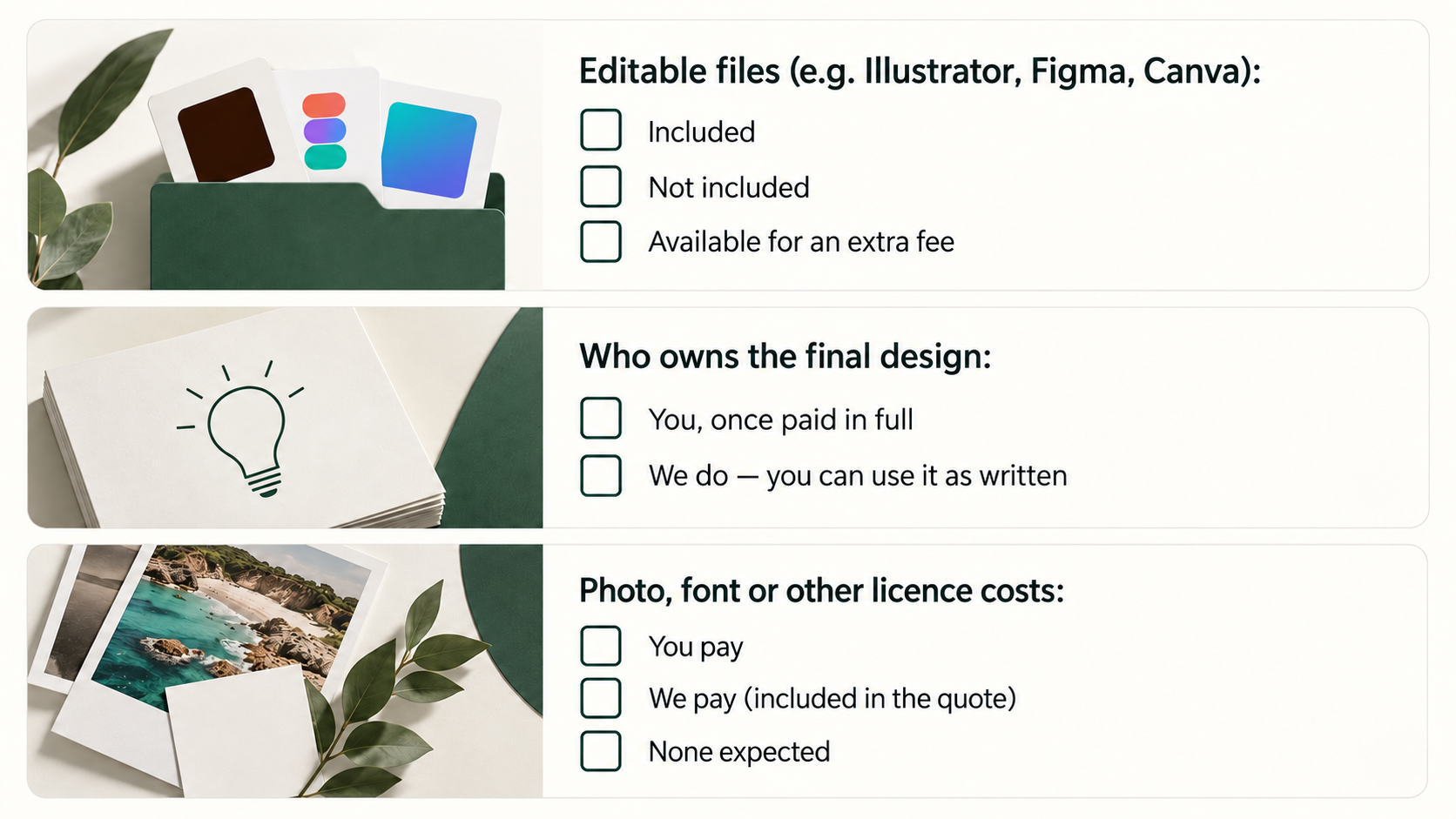
Three tick-box questions:
- Editable files (Illustrator, Figma, Canva): included, not included, or available for an extra fee.
- Who owns the final design: the client once paid in full, or you, with the client allowed to use it as written.
- Photo, font or other licence costs: the client pays, you pay (included in the quote), or none expected.
The ownership question matters more than many freelancers expect. Business.gov.au says: Under IP laws, the contractor automatically owns any IP they create. If the hirer wants to own the IP, the contract must state this. Contractors should get legal advice about any clauses that give IP rights to the hirer.
(business.gov.au: Prepare a contract). Copyright also needs no registration: Copyright protection is free and automatic under the Copyright Act 1968.
(business.gov.au: Copyright). The template gives you the boxes; it does not tell you which one to tick. If you are not sure, get advice before you sign.
10. If something needs to change
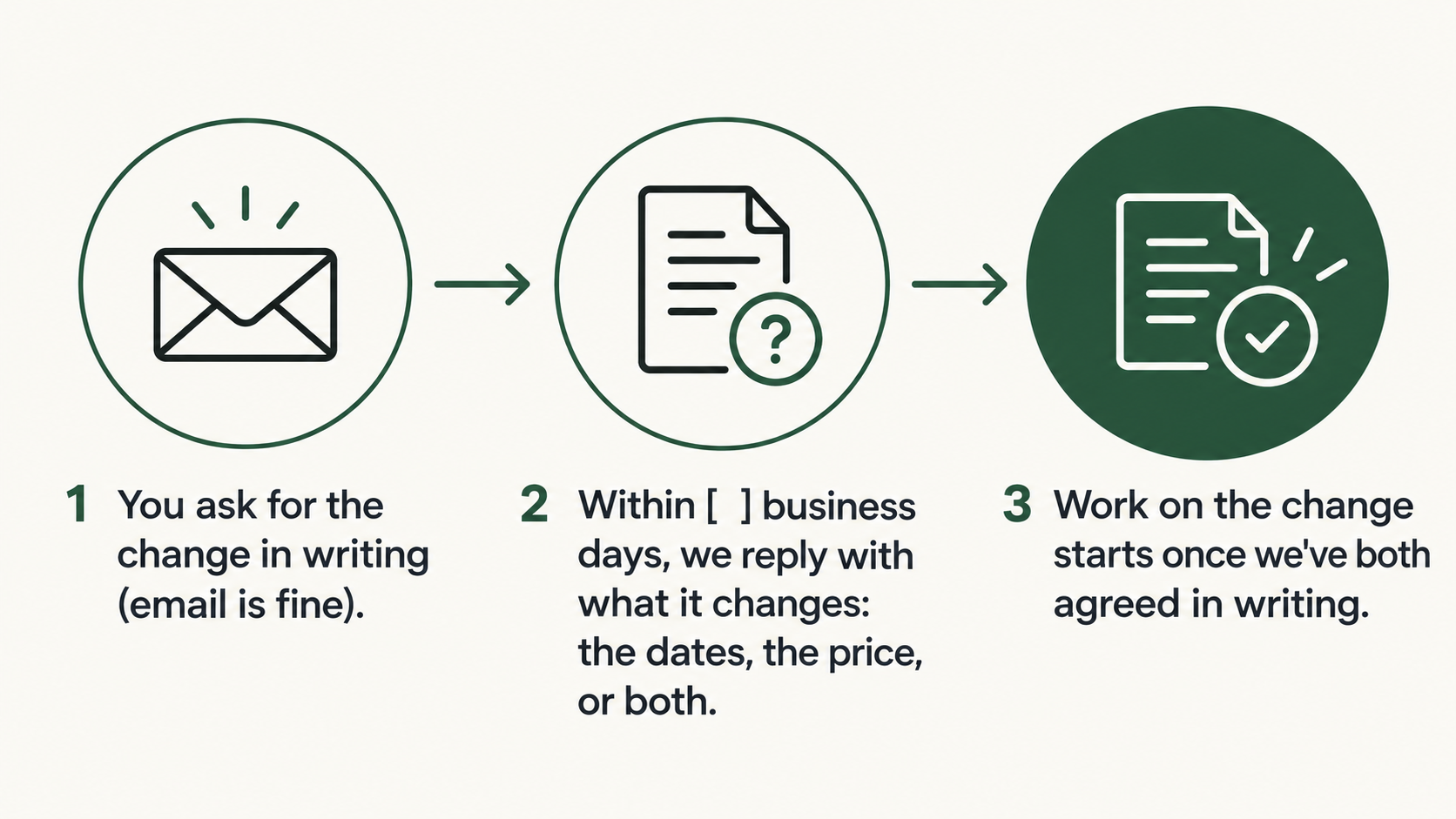
Three steps, written into the scope: the client asks in writing (email is fine); you reply within a set number of business days with what it changes (dates, price or both); work starts once you have both agreed in writing.
Business.gov.au’s advice on changes is that Contractors and hirers can make contract changes verbally, but it’s best to put them in writing and have both parties sign the document.
It also warns: Don’t agree to a variation clause that lets only one party change the work.
The three steps follow both points. How to price the change belongs in your quote, and what to say when a request arrives is covered in how to stop scope creep.
11. Price
One line: the quote number and date, the total in Australian dollars, and whether that total includes or excludes GST. Payment terms stay in the quote.
12. Agreement and signatures
Names, signatures and dates for both businesses, plus a line for “confirmed by email on”. The next section explains why both are there.
Is a scope of work a contract, and does it need to be signed?
It can be part of one. Business.gov.au says that If a customer accepts your quote, it becomes a legally binding contract.
(business.gov.au: Prepare quotes). A scope of work that the quote refers to, and that both of you have agreed to, is part of what was accepted. Whether a particular document is binding in a dispute is a legal question this guide does not answer.
On signatures, the government’s contract page lists: Signatures – both the contractor and hirer must sign the contract for it to be valid.
So the template’s first choice is that both of you sign and keep a copy. Some small clients will not print, sign and scan anything. For them, the template has a fallback: send the scope by email and ask them to reply confirming they agree. Keep that reply. It is a written record of what you agreed, which is better than an agreement made over the phone. It is not the same as a signature.
Keep the language plain. Business.gov.au advises: Use simple and plain language so you both easily understand the contract.
That is why the template uses “we” and “you” and the business names, and avoids “the Principal” and “the Contractor”.
A filled-in example: a café reopening (fictional)
The example file continues the café job from the creative brief example. Everything in it is made up. The parts that do most of the work:
- Deliverables: a refreshed logo (1 design in 3 colour versions; AI, PDF and PNG), an A4 double-sided menu (print-ready PDF plus an editable file), an A2 window poster, and 6 square Instagram posts with matching story sizes.
- Not included: printing (the client pays the printer directly), the coffee cup stamp, photography, writing the menu wording, website changes and posting to Instagram.
- Client supplies: menu wording and prices, and the printer’s file specifications, by Fri 23 Oct 2026. The fit-out photos and old logo came with the brief.
- Rounds: 2 per item, feedback within 2 business days of each draft, extra rounds quoted in writing first.
- Dates: first drafts Mon 26 Oct 2026 (can move), final OK Fri 6 Nov 2026 (cannot move, because the printer needs files by Mon 9 Nov) and final files Mon 9 Nov 2026 (cannot move, because reopening day is Sat 21 Nov).
- Files and rights: the logo (AI) and an editable Canva menu are included, so the owner can change prices; the café owns the final design once paid in full; fonts have a free commercial licence, and any stock photo will be confirmed before buying.
- Price: one line pointing to quote Q-0001 of Mon 19 Oct 2026, excluding GST. The amount is masked in the example.
Compare that with “logo, menu and some social posts, done before the reopening”. Both describe the same job. Only one tells you what to do when the owner asks for a loyalty card in week two.
What happens after the client signs?
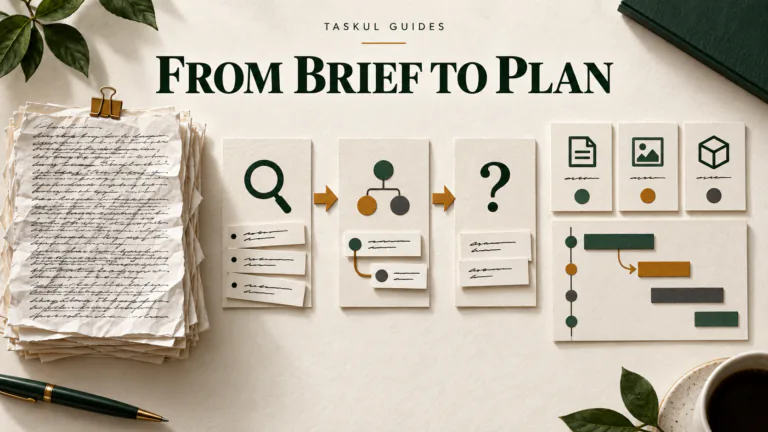
The scope becomes your checklist. The items in section 3 become tasks, the dates in sections 5 and 8 go into your calendar, and section 6 tells you how many rounds you have left for each item. Our guide to client brief to project plan walks through that step, and the freelance project checklist covers the rest of the job through to final files.
This is also where a project tool helps. TASKUL, which publishes this guide, is our product: paste the agreed scope into it and its AI writes the tasks and requirements for you to review. When the client asks for something new, it picks up what changed. A spreadsheet works too. What matters is that the client’s dates and your rounds are somewhere you check every day, not only in a signed file in your downloads folder.
Scope of work template FAQ
Should a scope of work include pricing?
Only a pointer to it. Put the price, GST and payment terms in the quote, and refer to the quote by number and date in the scope. Then there is only one place to update if the price changes.
Who writes the scope of work, the freelancer or the client?
The person doing the work usually writes it, because you know what each item involves. The client’s part is to read it, ask questions and agree. If they filled in a creative brief, much of sections 2, 5 and 8 can be copied from their answers.
How long should a scope of work be?
As short as the job allows. Business.gov.au notes that A short, simple contract may do for some jobs.
For a small design or web job, the template’s 12 sections are usually enough. Delete the sections that do not apply rather than writing “n/a”.
What is the difference between a scope of work and a statement of work?
People use the two names in different ways. In large IT and consulting projects, a statement of work is often a longer document that includes the scope, the price and the contract terms. For a freelance creative job, the same ground is usually covered by a scope of work plus a quote, which is the split this template uses.
Is this the same as a builder’s scope of works?
No. In Australian building and renovation work, “scope of works” usually means a list of construction tasks and materials. This template is for creative and digital work: design, websites, video, content and social media.
Can I use the template in Google Docs?
Yes. Paste the plain-text version into a new Google Doc and share it with the client, or open the Word file in whichever editor you use. The sections are the same in all three files.