
Most freelance onboarding advice is about making a good impression: a welcome pack, a kickoff call, a tidy folder structure. Useful, but it is not what onboarding is for. Onboarding is where you collect the six or seven pieces of information that will otherwise stop you dead in week three, and in Australia two of them are about how the client’s accounts department works, not about the project at all.
Get those in the first 48 hours, while the client is still enthusiastic and answering quickly, and the rest of the job runs. Ask for them in week five, when you need a login at 9pm or an invoice has just bounced, and you are the one waiting.
Why does onboarding decide whether you get paid on time?
Because late invoices are often not disputes. They are invoices sitting in the wrong inbox, missing a purchase order number, or made out to an entity that does not exist in the client’s system. Nobody is refusing to pay you. The document simply cannot travel through their process, and the person you have been emailing about the project has no visibility of that.
Your day-to-day contact is usually a marketing or operations person. The person who pays you is usually not. Onboarding is the one moment where asking about both is completely normal.
The seven things to collect in the first 48 hours
1. The legal entity name and ABN you invoice
Ask for the exact entity name and ABN to bill, not the brand name on the website. A business often trades under a name that is not the legal entity, and many groups have several. An invoice made out to the trading name can bounce in an accounts payable system that only recognises the registered entity.
This also matters for your own paperwork, because a tax invoice for a sale of $1,000 or more has to show the buyer’s identity or ABN under the ATO’s tax invoice requirements. You cannot supply what you were never given.
2. Whether they need a purchase order number
Ask the question plainly: “Does your accounts team need a PO number on the invoice?” Larger organisations very often do, and an invoice without one is not rejected so much as ignored, which is worse because nothing tells you it happened.
If they need one, get it before you start, not with the first invoice. Raising a PO can take a week on their side and it is entirely outside your control.
3. Where invoices actually go
Not “I’ll send it to you” — an email address for accounts, or the name of their supplier portal. If it is a portal, find out now whether you have to register, because that is a form, an approval and sometimes a week.
4. Their payment terms, in days
You put terms on your quote. They may have their own, and if the difference is not resolved now it is resolved by them, silently, thirty days from now. Ask what their standard terms are and reconcile the two while nobody is owed anything.
5. Who approves the work, and who else sees it first
A project with one approver and a project with a committee are different jobs. Ask who signs off and who reviews before that, by name. This is not bureaucracy. It is the difference between a revision round and four.
6. Everything you need from them, with dates
Logins, brand files, copy, product information, access to whoever holds the thing you need. Ask for all of it in one message, as a list, with a date next to each item.
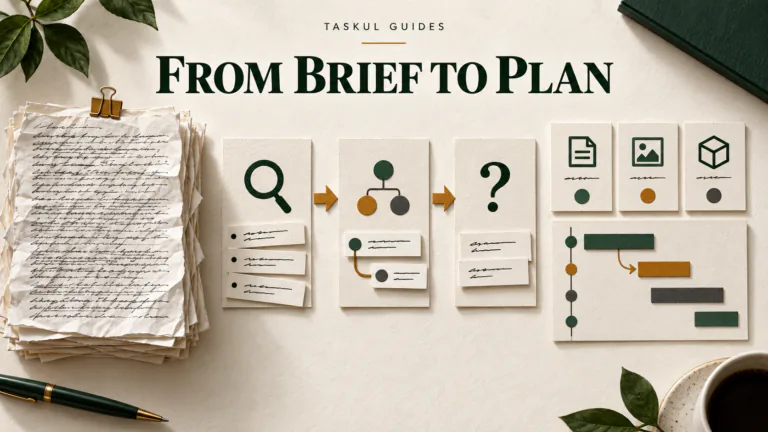
One message with five numbered items gets answered. Five messages over two weeks train the client that your requests are background noise. This list belongs in the same task list as your own work, which is the point we make in how to turn a client brief into a project plan.
7. How you will communicate, and how fast
Say it once, at the start, in writing: which channel, and what your response window is. “Email is best, and I reply the same day.” Almost nobody objects. What damages trust later is not being slow, it is being unpredictable.
The onboarding message that does all of it
One email, sent the day the work is confirmed, before anything else:
“Great to be working with you. So I can set everything up cleanly, could you send me these seven things this week?
1. The entity name and ABN to make invoices out to
2. Whether your accounts team needs a PO number, and if so the number
3. The email address or portal invoices should go to
4. Your standard payment terms
5. Who approves the work, and anyone who reviews before that
6. Logos, brand files and final copy — I need these by the 9th to hold the 20th
7. Logins for the site and the analytics account
I’ll work in email and reply the same day. Anything outside the quote I’ll price and confirm in writing before I start it.”
It takes four minutes to write and it removes almost every avoidable delay from the project. It also signals something useful about you before you have delivered anything: that the admin will be handled.
What about a contract?
A signed contract is better than no contract, and an accepted quote is already a long way ahead of nothing. business.gov.au’s guidance on preparing quotes explains that a quote your client accepts generally forms a legally binding contract, which means the scope and exclusions you wrote are doing real work whether or not anything was signed.
If a job is large enough that you would be in trouble if it went wrong, get a contract reviewed by someone qualified. For the ordinary run of freelance projects, the written quote plus the confirmation email is the practical baseline. What to put in the quote is in how to write a quote for freelance work in Australia.
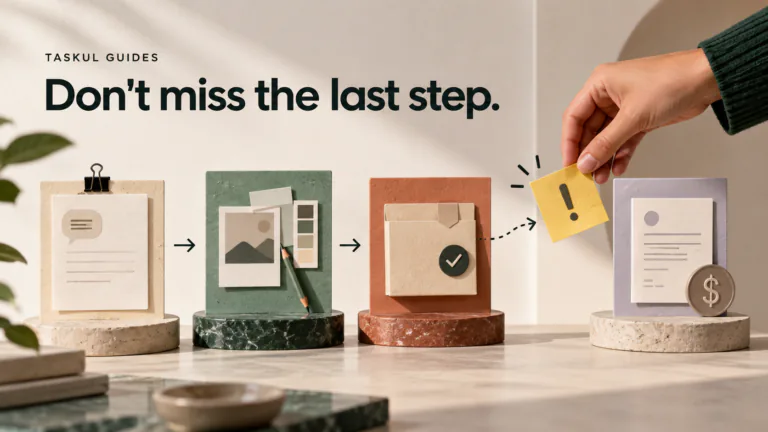
Onboarding is the first of four points in a job where files, scope and payment tend to slip. The freelance project checklist covers the other three.
Set up the follow-ups before you need them
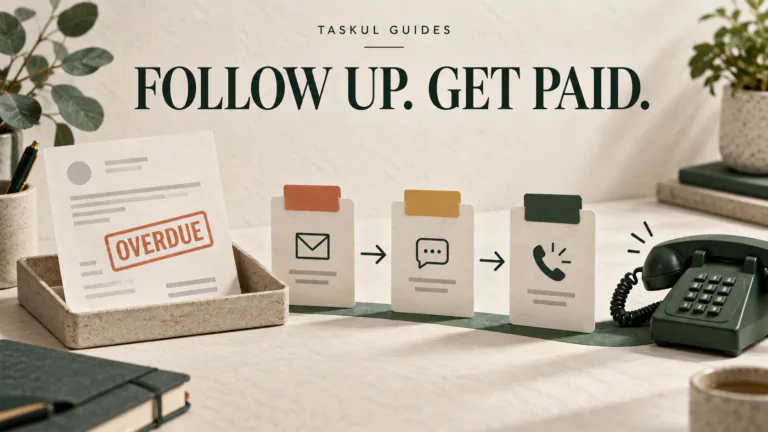
While you are setting up the project, create the tasks you will need later and date them: the invoice on the delivery date, a follow-up seven days after terms lapse, and a second one a week after that.
Doing this on day one rather than on the day the money is late changes the tone of everything that follows, because a scheduled reminder is routine and a remembered one is emotional. The sequence, and where it goes if the client still does not pay, is in how to chase late payments as a freelancer in Australia.
What not to do in onboarding
- Do not send a fifteen-page welcome pack. It will not be read, and it buries the seven things you actually need behind your process documentation.
- Do not ask for everything “when you get a chance”. Every item needs a date, or it arrives after it was needed.
- Do not start work to be helpful while a key item is missing. Starting without the brand files means you will build twice, and the second build is unpaid.
- Do not skip onboarding for a small job. The entity name and the PO question take one line each, and a $900 invoice can sit unpaid for exactly the same reasons a $9,000 one can.
Frequently asked questions
Is it rude to ask about payment terms before starting?
No, and the people who pay you expect it. Every supplier that business works with asks the same questions. Asking at the start reads as competence. Asking after an invoice is late reads as a complaint, which is the version you want to avoid.
What if the client will not give me a PO number?
Ask whether one is required, and if the answer is yes, ask when it will be raised. If it is not required, get that in writing in one line so that a later “we can’t pay without a PO” has a clear answer already sitting in the thread.
Should I onboard a returning client again?
Ask the short version: same entity, same PO process, same approver, same terms. All four change more often than you expect, especially the approver. Two lines now beats a bounced invoice later.
How much should I explain about how I work?
Two things only: which channel to use, and what your response window is. Everything else about your process is interesting to you and irrelevant to them. What they want to know is when they will see something and what it will cost if they change their mind.
What do I do if onboarding reveals the job is bigger than I quoted?
Say so immediately, before any work starts, with a revised number and the reason. “Now that I’ve seen the site, the build is six templates rather than four — here’s the updated quote.” Day one is the cheapest possible moment to have that conversation, and the client will take it far better than they would in week four.